Finding a broker is easy. Figuring out which Greenville broker can properly support your employees, HR team, budget, and long-term benefits strategy is much harder. Local employers may want to consider firms such as Alera Group, HUB International, Brown & Brown, Beckham Ellis Insurance Group, and Cavalry Partners, but no single firm is right for every company.
This article is for Greenville employers who want to build a practical shortlist, compare brokers fairly, and know what to verify before making a decision.
Key Takeaways
- A practical Greenville shortlist includes Alera Group, HUB International, Brown & Brown, Beckham Ellis Insurance Group, and Cavalry Partners.
- There is no single best broker for every employer. Company size, workforce needs, funding structure, budget, and service expectations all affect the decision.
- Do not compare brokers using premiums alone. Look at renewal planning, administration, compliance support, employee communication, reporting, and account access.
- Ask who will manage your account and how the firm is paid. These details should be clear before you appoint a broker.
- Verify licenses, references, and service claims. A broker’s website can help you build a shortlist, but interviews and written proposals should guide the final decision.
How This Greenville Broker Shortlist Was Built
This article is not a numbered ranking or a claim that one company is the best choice for every Greenville employer. The brokers included here were selected based on several practical factors:
- A Greenville office or clearly stated service presence in the area
- Publicly listed employer health insurance or employee benefits services
- Information about plan strategy, administration, compliance, cost management, or employee support
- A clear focus on businesses rather than mainly individual insurance customers
- Enough public information for an employer to make an initial comparison
The word “top” should not be treated as a universal rating. A large manufacturing company considering self-funding may need a very different broker from a small professional office offering its first group health plan. Use this shortlist as a starting point, then compare each broker against your company’s actual needs.
Employer Health Insurance Brokers Serving Greenville
The brokers below have different strengths, service models, and areas of focus. Their inclusion does not guarantee that they will be the right fit for your organization.
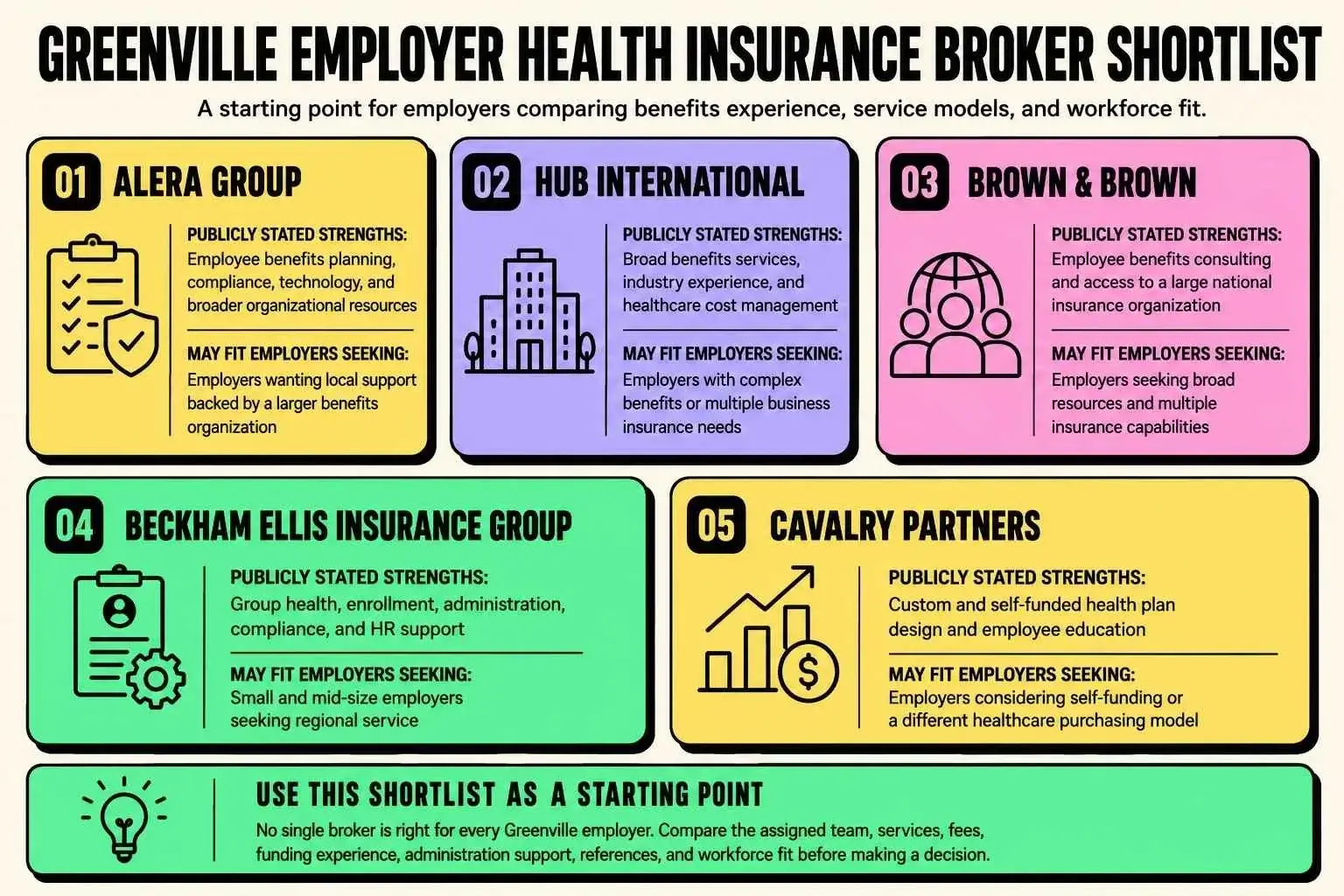
Broker | Publicly stated strengths | Employers that may want to investigate further |
Alera Group | Employee benefits planning, compliance, technology and broader organizational resources | Employers wanting local support backed by a larger benefits organization |
HUB International | Broad benefits services, industry experience and healthcare cost management | Employers with complex benefits or multiple business insurance needs |
Brown & Brown | Employee benefits consulting and access to a large national insurance organization | Employers seeking broad resources and multiple insurance capabilities |
Beckham Ellis Insurance Group | Group health, enrollment, administration, compliance and HR support | Small and mid-size employers seeking regional service |
Cavalry Partners | Custom and self-funded health plan design and employee education | Employers considering self-funding or a different healthcare purchasing model |
Alera Group
Alera Group lists employee benefits as one of its main business areas and describes support involving compliance, technology, communications, finance, and broader organizational resources. Its model may appeal to an employer that wants local guidance while still having access to specialists outside the immediate Greenville team.
Before choosing Alera Group, ask who would handle your account each day, which services would be delivered locally, and whether additional specialists are included in the standard agreement. Employers should also ask about experience with companies of a similar size and industry.
HUB International
HUB International has a Greenville office and identifies itself as a full-service broker offering employee benefits, business insurance, life insurance, and personal insurance. The Greenville office also lists experience with industries such as manufacturing, education, nonprofits, staffing, real estate, financial institutions, and professional services.
HUB may be worth considering for employers that have complicated benefits needs or want employee benefits and commercial insurance handled within one larger organization. Ask who will manage the relationship after the sale, which resources are available through the Greenville office, and whether any consulting or technology services carry separate fees.
Brown & Brown
Brown & Brown provides insurance, risk management, and employee benefits services through a large national organization. A Greenville Chamber listing also identifies a local Greenville office, while a broker directory describes the South Carolina team as serving employers and municipalities of different sizes.
This type of organization may interest employers that want broad capabilities, access to multiple insurance specialties, or support beyond medical benefits. Before moving forward, verify the current Greenville employee benefits team, the services included in the proposal, the markets the team can access, and who will be responsible for ongoing service.
Beckham Ellis Insurance Group
Beckham Ellis Insurance Group has a Greenville office and publicly promotes group health insurance, supplemental coverage, benefits planning, administration, and employee support. The agency also states that it works with different businesses and industries across the region.
It may be worth investigating for small and mid-size employers that value regional support and help with both plan selection and everyday benefits administration. During the interview, ask about carrier access, renewal preparation, employee enrollment support, HR tools, compliance assistance, and how quickly the team responds when an employee has a coverage problem.
Cavalry Partners
Cavalry Partners is based in Greenville and focuses heavily on employers that are self-funded or considering self-funding. Its public materials discuss custom plan design, implementation, employee education, and direct support for people using the health plan.
This approach may interest employers looking beyond a traditional fully insured renewal or wanting more control over how healthcare is purchased. Self-funding is not appropriate for every company. Ask about minimum employer size, financial risk, stop-loss coverage, consulting fees, implementation requirements, employee disruption, and results achieved for organizations with similar workforces.
How to Compare the Brokers on Your Shortlist
A familiar brand or impressive presentation does not tell you what the day-to-day relationship will be like. Compare every finalist using the same criteria. This makes it easier to separate a strong service model from a good sales pitch.
Plan Strategy and Funding Experience
A broker should be able to explain more than the difference between two carrier quotes. Ask about experience with:
- Fully insured group health plans
- Level-funded arrangements
- Self-funded health plans
- Stop-loss coverage
- Health reimbursement arrangements
- Individual Coverage HRAs
- Pharmacy benefit strategies
- Provider networks
- Dental, vision, life and disability coverage
- Voluntary and supplemental benefits
The goal is not to choose the firm that presents the most options. It is to find a broker that can explain which options fit your workforce and why. For example, a 25-person office offering benefits for the first time may need simple enrollment support and predictable costs. A 300-person employer with claims data may need deeper funding, pharmacy, and network analysis.
Service, Administration, and Employee Support
Many employers focus on the renewal quote and overlook what happens during the rest of the year. Ask each broker:
- Who will be our main contact?
- Who helps employees with coverage or claim problems?
- How are new hires, terminations, and qualifying life events handled?
- What enrollment technology is available?
- Who checks carrier and payroll deductions?
- When does renewal planning begin?
- What compliance help is included?
- How will employee questions be answered?
- What happens if our company adds another location?
A broker may provide a strong recommendation but still be the wrong fit if the service team is difficult to reach or responsibilities are unclear.
Fees, Data, and Accountability
Employers should understand how the broker is paid and what they will receive in return. Request clear information about:
- Carrier commissions
- Consulting or technology fees
- Additional administration charges
- Claims and utilization reports
- Renewal comparisons
- Industry or regional benchmarks
- Pharmacy spending analysis
- Employee participation data
- Service response expectations
- The process for measuring results
A broker cannot control every rate increase or claim. However, the firm should be able to explain what changed, what can be influenced, and what actions should be considered next.
Questions to Ask Before Choosing a Broker
Use the same questions with every broker on your shortlist. Consistent questions make proposals easier to compare.
- What sizes and types of employers do you serve most often?
- Who will manage our account after we sign?
- Which carriers, administrators, and funding arrangements can you evaluate?
- How is your firm compensated?
- Are all commissions and consulting fees disclosed in writing?
- How early do you begin preparing for renewal?
- What reports and data will we receive during the year?
- How do you support employees during enrollment and after coverage begins?
- Which compliance services are included?
- Can you provide references from employers with similar needs?
- How do you measure whether your recommendations are working?
- What responsibilities will remain with our internal HR team?
Pay attention to the clarity of the answers. If it is difficult to understand who handles a task during the sales process, it may be even more difficult after the relationship begins.
Why Local Market Fit Matters in Greenville
Greenville County had 15,493 employer establishments and 266,065 total employment in 2023, according to the U.S. Census Bureau. That includes organizations with very different industries, workforce sizes, budgets, and administrative needs. A local address alone does not prove that a broker understands your company. A useful local partner should be able to discuss:
- The type of workers you employ
- Whether employees work at one site or several
- Hiring and retention concerns
- Employee access to doctors and facilities
- Your internal HR capacity
- The company’s growth plans
- How employees prefer to receive benefits information
A broker serving a large manufacturer may use a different approach from one serving a small medical practice, restaurant group, nonprofit, or professional office. Local experience matters most when it leads to better questions, clearer service, and recommendations that reflect the workforce.
Review Your Current Benefits Needs Before Choosing
A broker comparison becomes useful only when it is tied to your company’s real situation. Before requesting proposals, write down:
- Your employee count
- Current plan and funding arrangement
- Renewal date
- Employer contribution strategy
- Recent rate changes
- Administrative problems
- Common employee complaints
- Benefits employees frequently request
- Planned hiring or location growth
- The support your HR team needs most
Then compare every broker against the same list. Ask who will manage the account, how renewals are prepared, what reports you will receive, how employee questions are handled, and how fees are disclosed. A strong proposal should explain the service model as clearly as it explains the insurance options. Employers can also review Benni Agency’s Greenville benefits support to understand available medical, supplemental, tax-advantaged, and benefits administration options.
The goal is not to change brokers simply because another firm made a polished presentation. It is to confirm that your current or future partner fits your workforce, budget, and service expectations. Start by comparing your current service, costs, and employee needs against the same standards you will use for each new broker.