Is your broker sending renewal information at the last minute, leaving HR to handle employee questions, or contacting you only during open enrollment? A Santee insurance broker should work with your business throughout the year, helping you review costs, compare plans, manage enrollment, support employees, and prepare early for renewal.
This article is for Santee business owners and HR leaders who want clearer benefits decisions, fewer administrative problems, and a better way to judge whether their broker is providing enough support.
Key Takeaways
- A broker should understand your workforce, budget, and business goals before recommending plans.
- Support should continue throughout the year, not stop after open enrollment.
- Plan comparisons should clearly explain employer costs, employee costs, coverage differences, and trade-offs.
- Benefits technology should reduce paperwork, enrollment errors, and manual HR work.
- Options such as ICHRA should be reviewed only when they fit the business and its employees.
How Should a Santee Insurance Broker Work With Your Business?
A Santee insurance broker should work as a year-round employee benefits partner, not simply collect quotes once a year.
The broker should first learn how your company operates. That includes understanding your workforce, current coverage, budget, employee concerns, hiring plans, and administrative process. Recommendations should be based on that information rather than a standard package used for every employer. A strong broker should also help with:
- Plan and carrier comparisons
- Employer contribution planning
- Enrollment preparation
- Employee communication
- New-hire and eligibility changes
- Benefits administration
- Renewal strategy
- Carrier issue escalation
- Compliance-related coordination
The relationship should leave your business with clearer decisions and less confusion. If HR still has to chase every answer, correct repeated enrollment problems, and explain every plan change alone, the broker may not be doing enough.
The Relationship Should Start With Your Business, Not a Quote
A broker cannot recommend the right benefits structure without first understanding the company. Before requesting quotes, the broker should ask about:
- The number of eligible employees
- Full-time and part-time roles
- Employee locations
- Current participation rates
- Employer contribution levels
- Recent premium changes
- Employee feedback
- Payroll and HR systems
- Recruiting and retention goals
- Expected business growth
These details affect which plans are practical. For example, a company with employees in several locations may need different provider access than a business with everyone working in Santee. A growing employer may also need an enrollment process that can handle frequent new hires without creating more manual work for HR.
The lowest premium is not always the best choice. A plan may look affordable but have limited provider access, high employee costs, or participation rules that make it difficult to maintain. A good broker should explain those issues before asking the employer to make a decision.
Your Broker Should Provide Support Throughout the Year
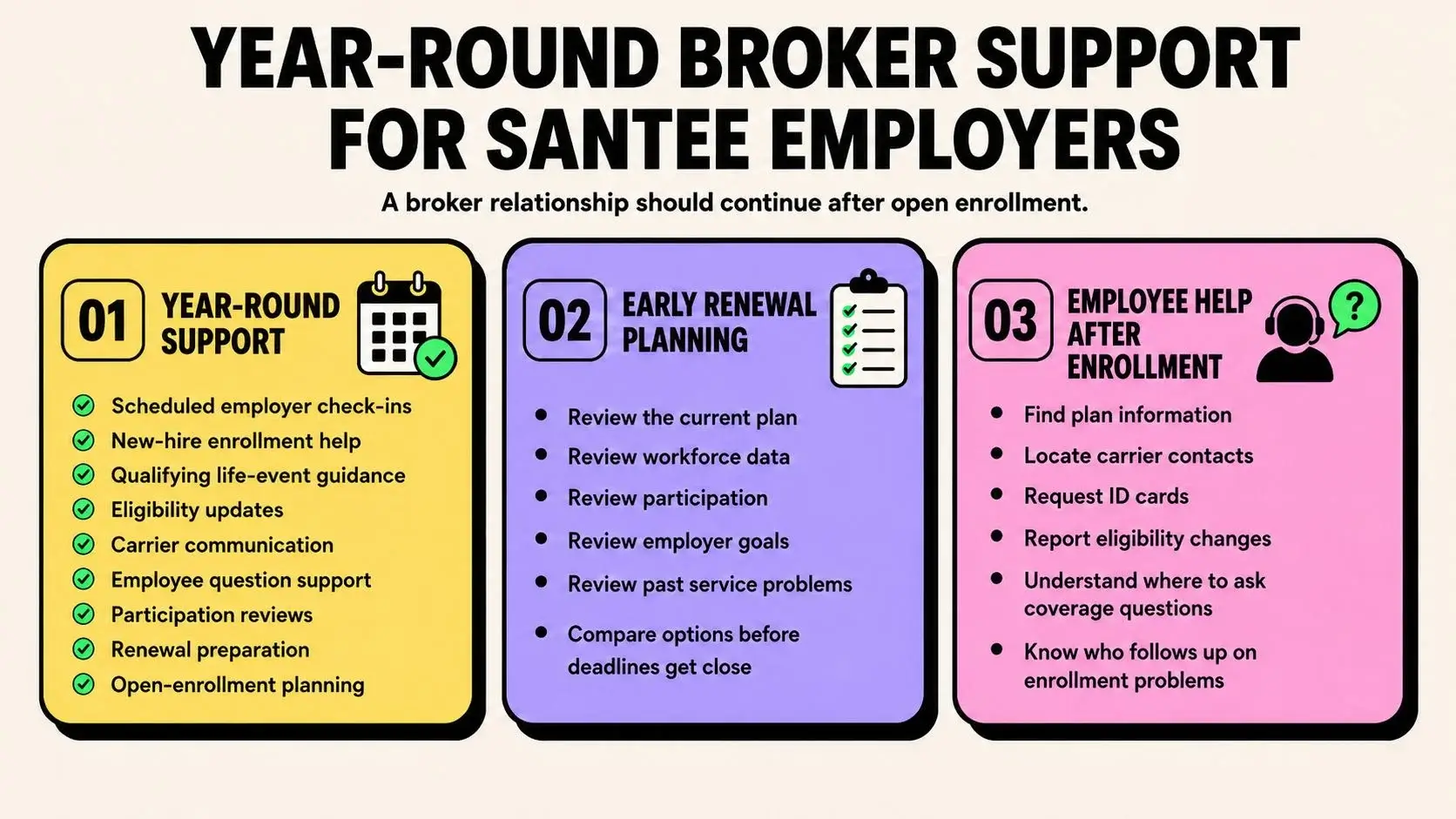
Benefits work does not end when employees finish enrollment. Employees get hired, leave the company, move, get married, have children, and experience other eligibility changes. Payroll deductions may need corrections. ID cards may be delayed. Carrier records may not match the employer’s information. Your broker should provide a clear process for handling these issues. Year-round support may include:
- Scheduled employer check-ins
- New-hire enrollment help
- Qualifying life-event guidance
- Eligibility updates
- Carrier communication
- Employee question support
- Participation reviews
- Renewal preparation
- Open-enrollment planning
The exact meeting schedule will depend on the size and needs of the business. What matters is that communication is planned. The employer should not have to wait until renewal to find out whether the benefits program is working.
Renewal Planning Should Begin Early
Late renewal information limits your choices. When rates and plan changes arrive close to the effective date, employers have less time to compare options, approve contributions, update payroll, prepare enrollment materials, and explain changes to employees.
A broker should begin by reviewing the current plan, workforce data, participation, employer goals, and any service problems from the past year. The broker can then request options and explain how each one affects both the company and its employees. Early preparation does not guarantee lower rates. It does give the employer more time to make a careful decision instead of accepting a plan because the deadline is close.
Employees Should Have Help After Enrollment
Employees may understand their benefits during an enrollment meeting and still have questions later. They may need help finding plan information, locating carrier contacts, requesting an ID card, reporting an eligibility change, or understanding where to ask a coverage question. A broker should explain:
- Which questions the broker can handle
- Which issues must go to the carrier
- Where employees can find plan documents
- How HR should submit employee changes
- Who follows up when an enrollment problem occurs
The broker cannot guarantee a claim decision or replace the insurance carrier. Still, the broker can help employees and HR find the right contact and understand the next step. That support reduces avoidable back-and-forth for the employer.
Plan Recommendations Should Explain Costs and Trade-Offs
A useful plan comparison should show more than monthly premiums. Employers need to understand how each option affects:
- Employer contributions
- Employee payroll deductions
- Deductibles
- Copays and coinsurance
- Out-of-pocket limits
- Provider networks
- Prescription coverage
- Participation requirements
- Administration
- Broker fees or commissions
A lower-cost plan may move more expense to employees through higher deductibles or narrower networks. A richer plan may offer better coverage but place too much pressure on the employer’s budget. Neither option is automatically right or wrong.
The broker should clearly explain what changes, who pays more, who gains more coverage, and what new administrative work may be required. Employers should also be able to ask how the broker is paid and which services are included.
When an ICHRA May Be Worth Reviewing
A traditional group health plan remains a good fit for many businesses. Other employers may benefit from reviewing ICHRA options.
An Individual Coverage Health Reimbursement Arrangement allows an employer to provide a set allowance that eligible employees can use toward individual health insurance. It may be worth discussing when an employer wants:
- More control over contribution amounts
- Greater employee plan choice
- Different employee classes
- A structure that can grow with the company
- An alternative to a difficult group renewal
- Coverage options for employees in different areas
ICHRA is not an automatic solution. The broker should review affordability, employee eligibility, plan availability, communication needs, and administration before recommending a change. Employees may also need more guidance because they are selecting individual coverage rather than joining one employer-sponsored group plan.
Technology Should Reduce Work, Not Create More of It
Benefits technology should make the process easier for HR and employees. A useful system can support:
- Digital enrollment
- New-hire onboarding
- Eligibility tracking
- Employee elections
- Payroll deductions
- Plan documents
- Life-event changes
- Carrier files
The goal is not to add another platform that HR must manage alone. The broker should help set up the process, explain how it works, and provide support when information does not transfer correctly. A strong benefits administration platform can reduce paper forms, duplicate data entry, missed changes, incorrect deductions, and repeated follow-up emails.
Technology still needs human support. Software may record an employee election, but it cannot always explain why a deduction is wrong or follow up with a carrier when coverage is missing.
Why Local Understanding Matters in Santee
A local broker should offer more than a nearby address. The broker should understand where employees live and work, which provider networks are practical, how the company hires, and whether the workforce includes different schedules, job types, or locations.
Santee is part of the wider Orangeburg County employer market. The U.S. Census Bureau reported 25,672 total employment positions in Orangeburg County in 2023. That figure does not describe Santee alone, but it shows that local businesses operate within a broader regional workforce.
Each employer still needs an individual review. A plan that works for a small office may not work for a company with hourly staff, seasonal hiring, several locations, or employees living across different counties. Local knowledge should help the broker ask better questions. It should never replace a proper review of the business.
Signs Your Current Broker Relationship Needs Attention
One missed call does not always mean you need a new broker. Repeated service problems are different. Your current relationship may need a closer review if:
- Renewal information repeatedly arrives late
- You do not know who manages your account
- Emails and employee issues go unanswered
- HR handles most enrollment problems alone
- Employees do not understand their benefits
- Fees or commissions are unclear
- The broker recommends plans without reviewing workforce data
- Alternative plan structures are never discussed
- There is little communication after enrollment
- Technology creates more work instead of reducing it
Look for patterns rather than one isolated mistake. A broker may be able to correct a communication problem or improve the enrollment process. If the same problems continue each year, the issue may be the service model rather than one difficult renewal.
Questions to Ask a Santee Insurance Broker
Whether you are reviewing your current broker or speaking with a new one, ask questions that reveal how the relationship will work. Useful questions include:
- When do you begin preparing for renewal?
- Who will manage our account and answer day-to-day questions?
- How often will you check in with us during the year?
- How do employees get help after enrollment?
- What benefits administration support is included?
- How do you compare traditional group plans with ICHRA or other structures?
- How are you compensated?
- What happens when an enrollment or carrier issue cannot be resolved quickly?
- How will you measure whether our benefits strategy is working?
Pay attention to the detail in each answer. A broker should be able to explain the actual process, not simply promise good service. You should know who will do the work, what happens at each stage, and what responsibilities remain with your HR team.
A Better Benefits Process Starts With a Clear Review
Before changing plans or choosing another broker, look closely at how your current benefits process works. Are renewal decisions arriving early enough? Can employees get clear answers? Does HR have reliable enrollment and eligibility support? Are costs and plan trade-offs explained before a recommendation is made?
A review can help separate a temporary service problem from a larger gap in strategy, communication, or administration. It may also show that the current plan is still suitable but needs better employee education or a cleaner enrollment process. Benni Agency helps employers review their current benefits setup, identify areas creating unnecessary work, and understand which options deserve further consideration. The goal is not to change coverage simply to make a change.