A benefits broker should do more than present plan options once a year. Orangeburg employers need a partner who can guide the renewal process, manage enrollment, answer employee questions, address payroll or coverage errors, and help prevent problems before they grow. Reviewing your broker’s service can reveal whether your business is receiving the year-round support it needs.
This article is for Orangeburg business owners and HR leaders who want to know what useful broker support looks like and where their current service may be falling short.
Key Takeaways
- A broker should understand your workforce, budget, hiring needs, and administrative capacity before recommending coverage.
- Plan comparisons should explain costs, networks, employee choice, contributions, and administrative demands.
- Broker support should continue after enrollment through eligibility changes, billing help, employee questions, and renewal planning.
- Technology should reduce manual HR work without replacing access to a real person.
- Employers should receive clear information about broker compensation, compliance support, and year-round responsibilities.
What Should an Orangeburg Benefits Broker Handle?
A benefits broker should do more than collect quotes from insurance carriers. The broker needs to understand how your company operates before recommending a plan. That includes reviewing your employee population, employer budget, current benefits, hiring goals, turnover, contribution strategy, and the amount of work your HR team can manage.
The recommendation should reflect those findings. A plan that works for a small professional office may not fit a shift-based manufacturer, healthcare employer, or company with workers at several locations.
Understand the Workforce and Employer Budget
Before discussing plans, a broker should ask practical questions:
- How many employees are eligible?
- Do employees work fixed shifts, changing schedules, or remotely?
- How much can the company contribute?
- Are dependent premiums difficult for employees to afford?
- Does the company struggle to recruit or retain certain positions?
- How much administrative support does HR have?
- Are employees concentrated in Orangeburg or spread across several areas?
These details affect plan participation, employee communication, network needs, and contribution decisions. The broker should also look at how the workforce may change. A company preparing to hire 20 employees needs a different strategy from one expecting its headcount to remain steady.
Compare the Right Coverage and Funding Options
There is no single plan structure that fits every employer. A broker should explain which choices deserve consideration and why. The review may include:
- Traditional fully insured group coverage
- Level-funded plans
- Health reimbursement arrangements
- Dental and vision coverage
- Life and disability insurance
- Accident, critical illness, or hospital indemnity plans
- Health savings accounts or flexible spending accounts
For some employers, the conversation may also include ICHRA options, which allow the company to provide a defined allowance that eligible employees can use toward individual health coverage. A broker should not present any option as an automatic answer. Workforce size, employee locations, participation, cash flow, risk tolerance, and administrative capacity all affect whether a plan is worth considering.
Explain Recommendations Clearly
A proposal is not useful if the employer cannot understand the differences between the choices. The broker should explain:
- What the company will pay
- What employees will pay
- How deductibles and copays differ
- Which doctors, hospitals, and pharmacies are in the network
- How prescription coverage works
- Whether employees have meaningful plan choices
- What administrative work each option creates
- What could change at renewal
The lowest premium is not always the best value. A cheaper plan may have a narrow network, a high deductible, weak prescription coverage, or contribution requirements that reduce employee participation. Employers need to understand those trade-offs before making a decision.
A Broker Should Support More Than the Annual Renewal
Does your broker become difficult to reach once open enrollment ends? A useful broker relationship continues throughout the year. Employees get hired, leave the company, add dependents, lose other coverage, move, and experience billing or eligibility problems. HR needs a clear process for handling those changes. The broker should help coordinate that process instead of leaving the employer to work through every carrier issue alone.
Prepare Early for Renewal
Renewal planning should begin before the carrier proposal arrives. An early review gives the employer time to examine:
- Current premiums and employer contributions
- Employee participation
- Plan usage information when available
- Common employee complaints
- Network or prescription issues
- Administrative problems
- Hiring and retention needs
- Expected changes in headcount or budget
Waiting until the final weeks can limit the time available to compare plans, model contributions, prepare employee materials, and address implementation questions. The broker should set a renewal schedule, explain the decisions that need to be made, and keep the process moving.
Manage Enrollment and Eligibility Changes
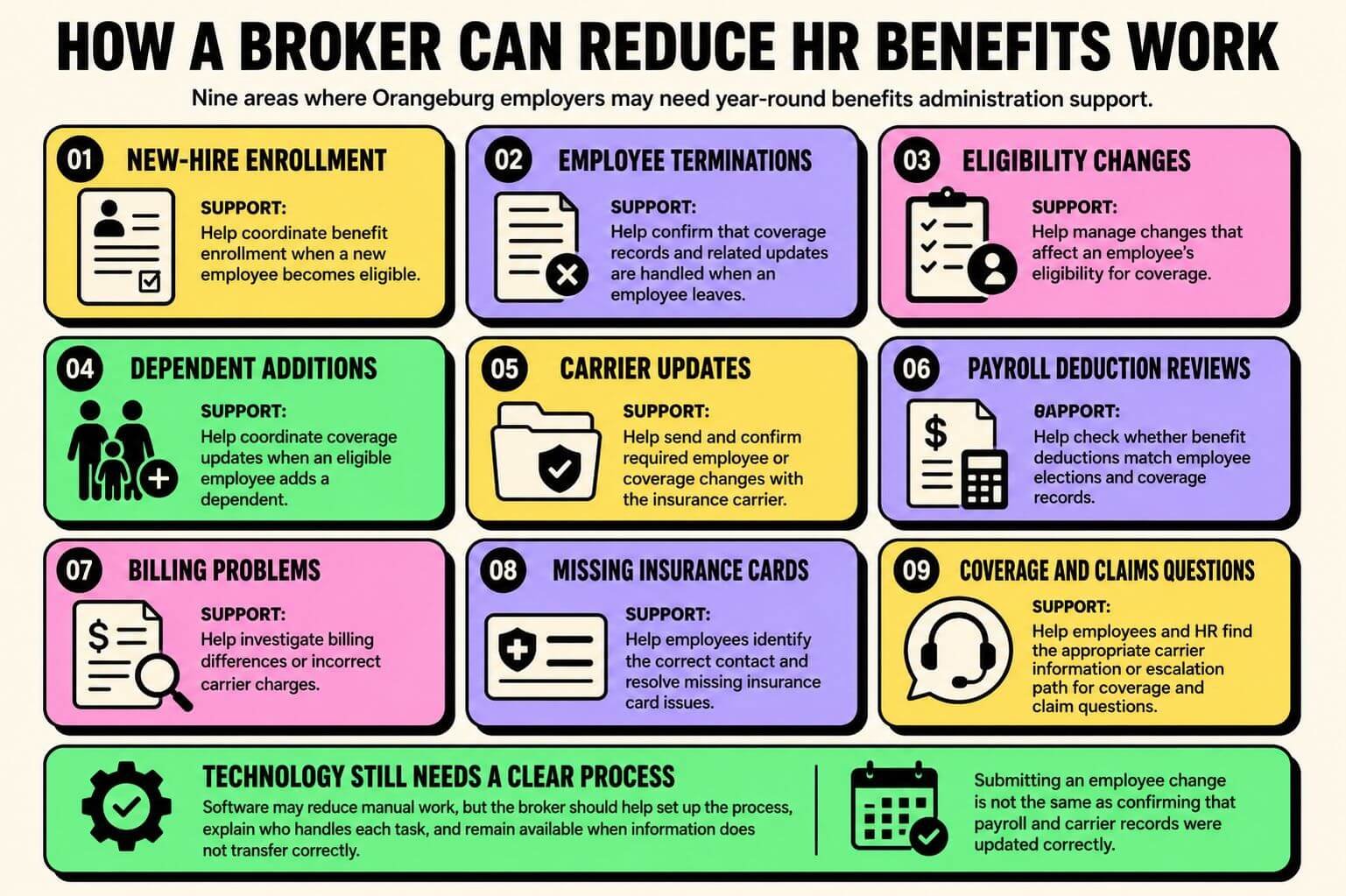
Enrollment involves more than asking employees to select a plan. A broker should help establish clear steps for:
- New-hire enrollment
- Employee terminations
- Dependent additions and removals
- Qualifying life events
- Eligibility corrections
- Carrier enrollment files
- Payroll deduction updates
- Billing questions
- Missed or incorrect elections
The exact division of work varies by broker, carrier, platform, and employer. That is why responsibilities should be agreed upon before enrollment begins. HR should know who enters each change, who checks it, who sends it to the carrier, and who follows up when the information does not match.
Help Employees Understand Their Benefits
Employees may not use a benefit correctly if they do not understand it. A broker should help explain important details in plain language, including:
- Premium deductions
- Deductibles and out-of-pocket limits
- Copays and coinsurance
- Provider networks
- Prescription coverage
- Health savings accounts
- Voluntary benefits
- Enrollment deadlines
- Where employees should go for help
Support may include enrollment meetings, benefit guides, comparison materials, recorded presentations, or access to someone who can answer individual questions. Clear education helps employees make informed choices and reduces the number of basic questions sent back to HR.
How a Broker Should Reduce HR Work
Benefits administration can create hours of repetitive work. Employee information may need to be entered into several systems, payroll deductions may not match elections, and carrier records may not reflect recent changes. A broker should look for ways to reduce those problems. That does not mean adding technology simply because it is available. The system needs to fit the employer’s size, workflow, payroll setup, and internal resources.
Connect Enrollment, Payroll, and Employee Records
The broker should explain how benefits administration technology can support enrollment, onboarding, employee records, payroll deductions, and reporting. Useful technology may allow employees to review plans, make elections, and update personal information through one system. It may also reduce the need for HR to copy the same information between spreadsheets, forms, payroll, and carrier websites. Before choosing a platform, employers should ask:
- Which systems can connect?
- Who sets up and tests the connection?
- Who corrects errors?
- Can HR run useful reports?
- Can employees access their information?
- What support is available during enrollment?
- Are there additional fees?
A system only saves time when the process behind it is clear.
Provide a Clear Escalation Process
Employees sometimes receive an incorrect bill, appear inactive at a doctor’s office, or find that a dependent was not added correctly. A broker should explain how those issues will be handled. The process should identify:
- Where HR or the employee reports the problem
- What information is needed
- Who contacts the carrier or administrator
- When the employer can expect an update
- How unresolved issues are escalated
A broker cannot approve claims or override carrier rules. The broker can often help identify the right contact, gather information, follow up, and keep the employer informed. That support can save HR from spending hours contacting several departments without knowing who owns the problem.
Compliance Support Should Be Clearly Defined
Employee benefits involve eligibility rules, required notices, waiting periods, plan documents, Section 125 requirements, COBRA coordination, and Affordable Care Act responsibilities. A broker may provide reminders, document support, educational materials, technology, or referrals. The employer should still ask exactly what is included. Useful questions include:
- Who tracks notice deadlines?
- Who prepares or distributes required documents?
- Who handles COBRA administration?
- Who checks eligibility rules and waiting periods?
- Is Section 125 documentation included?
- What reporting support is provided?
- When should the employer speak with an attorney, accountant, or tax professional?
Employers should not assume that the broker handles every legal or administrative requirement. Clear responsibilities reduce the risk of a task being missed because each party thought someone else was managing it. The right benefits consulting support should make those responsibilities easier to understand without suggesting that a broker replaces legal or tax advice.
How Employers Can Measure Broker Performance
A broker relationship should be judged by more than the number of carrier quotes provided at renewal. Employers need to look at the service received across the full year.
Questions to Ask About Service
Ask how the broker handles everyday support:
- Who answers employee and HR questions?
- How quickly are new issues acknowledged?
- What support continues after enrollment?
- Who handles carrier escalation?
- How often will review meetings occur?
- What happens when the usual contact is unavailable?
- Will the broker help with billing and eligibility problems?
The answers should describe an actual process, not simply promise good service.
Questions to Ask About Costs and Compensation
Employee benefits brokers may be paid through carrier commissions, employer-paid fees, or both. Ask the broker to explain:
- How the firm is paid
- Which services are included
- Whether some services cost extra
- Whether compensation changes by carrier or product
- Whether any agreements limit the options presented
- How fees or commissions are disclosed
Compensation does not automatically indicate whether the advice is good or bad. Employers need enough information to understand the relationship and evaluate recommendations fairly.
Questions to Ask About Results
Not every result can be reduced to premium savings. Employers should also review how the broker affects administration, communication, and planning. Possible measures include:
- Renewal work started on schedule
- Plan comparisons delivered clearly
- Enrollment errors identified and corrected
- Employee meetings completed
- Participation reports provided
- Billing or eligibility issues resolved
- HR workload reduced
- Regular strategy meetings held
- Responsibilities documented
A broker should be able to explain what work was completed and what needs attention next.
Why Orangeburg Workforce Knowledge Matters
Orangeburg County supports a varied employer base. The Orangeburg County Development Commission identifies sectors such as automotive, advanced manufacturing, aerospace, agribusiness, and life sciences among the county’s target industries. Those employers may have very different workforces.
A manufacturer may need to communicate with employees across several shifts. An agribusiness may have seasonal staffing changes. A healthcare employer may compete for specialized positions. A professional office may have a smaller team with different expectations about plan choice and dependent coverage. Local knowledge should help a broker ask better questions about:
- Work schedules
- Employee locations
- Hiring needs
- Turnover
- Contribution affordability
- Access to providers
- Enrollment communication
- Internal HR resources
A local label alone does not make a broker useful. What matters is whether the broker understands how the company operates and uses that information when comparing benefits.
Review Your Benefits Strategy Before Renewal
A benefits review should begin before renewal proposals create an urgent deadline. Look beyond the new premium. Consider whether your current broker explains plan trade-offs, prepares early, supports employees, reduces administrative work, and stays involved when billing or eligibility problems arise. It also helps to review how much time HR spends correcting enrollment records, answering benefits questions, and coordinating between payroll, carriers, and employees. Those problems may reveal service gaps that are easy to overlook during renewal.
Benni Agency helps employers review their current benefit structure, administration process, and employee communication needs. The goal is not to change coverage without a clear reason. It is to identify what works, where support may be missing, and which options deserve a closer review.