Supplemental insurance can help employees handle costs that their main health plan or other core benefits may not fully address. Employers should compare options based on what each policy covers, how benefits are paid, employee costs, exclusions, limits, and how the coverage fits with existing benefits. Price matters, but it should not drive the decision alone.
This guide is for business owners and HR teams who want to compare supplemental benefits clearly, avoid unnecessary overlap, and choose options that make sense for their workforce.
Key Takeaways
- Start with employee needs, not product names. Look at whether employees need help with injuries, hospital stays, serious illnesses, lost income, or family protection.
- Compare more than premiums. Review benefit triggers, payout amounts, exclusions, waiting periods, limits, and portability.
- Check your current benefits first. Supplemental coverage should address a real financial gap instead of repeating protection employees already have.
- Consider who pays. Employer-paid, voluntary, shared-cost, and base plus buy-up approaches can affect affordability and participation.
- Look at administration too. Enrollment, payroll deductions, billing, claims support, and employee education affect how well a benefit works after launch.
What Should Employers Compare in Supplemental Insurance?
The first question should not be, “Which carrier has the lowest rate?” Start by asking what financial problem the benefit is supposed to address. Then compare the details that control how useful the coverage may be:
- What event triggers a payment?
- How is the benefit calculated?
- Are there waiting periods?
- What exclusions apply?
- Are there annual or lifetime limits?
- What will employees pay?
- Can employees keep the coverage after leaving?
- What enrollment or health information is required?
- How much work will HR have to manage?
Those questions make it much easier to compare plans on more than price.
Start With the Financial Risk Employees Face
Different supplemental benefits solve different problems. An employee injured in an accident may face costs that are different from someone hospitalized for an illness. An employee unable to work for several months may be more concerned about replacing income than paying a hospital bill.
Before adding coverage, review the risks your current package leaves employees to handle themselves. That might include unexpected medical expenses, income loss, or financial support for a family after a death.
Compare Benefit Triggers, Payouts, and Limits
Two plans with similar premiums can pay very differently. Look closely at what has to happen before benefits become payable. One policy may pay after a covered diagnosis, another after hospitalization, and another according to a schedule of covered accident-related treatments.
Employers should also review maximum benefits, exclusions, waiting periods, repeat-benefit rules, and any requirements for evidence of insurability. These details often tell you more about a policy than the monthly premium does.
Compare Employee Cost and Employer Contribution
How the coverage is funded also matters. Common approaches include:
- Employer-paid: The company pays the premium.
- Voluntary: Employees choose the coverage and pay the premium, often through payroll deductions.
- Shared cost: The employer and employee each pay part.
- Base plus buy-up: The employer funds a basic level and employees can purchase additional coverage.
There isn’t one funding model that works for every employer. Budget, employee affordability, participation goals, and the value of the benefit all play a part.
Supplemental Insurance Options Compared
A quick side-by-side view can help employers see why these products should not be treated as interchangeable.
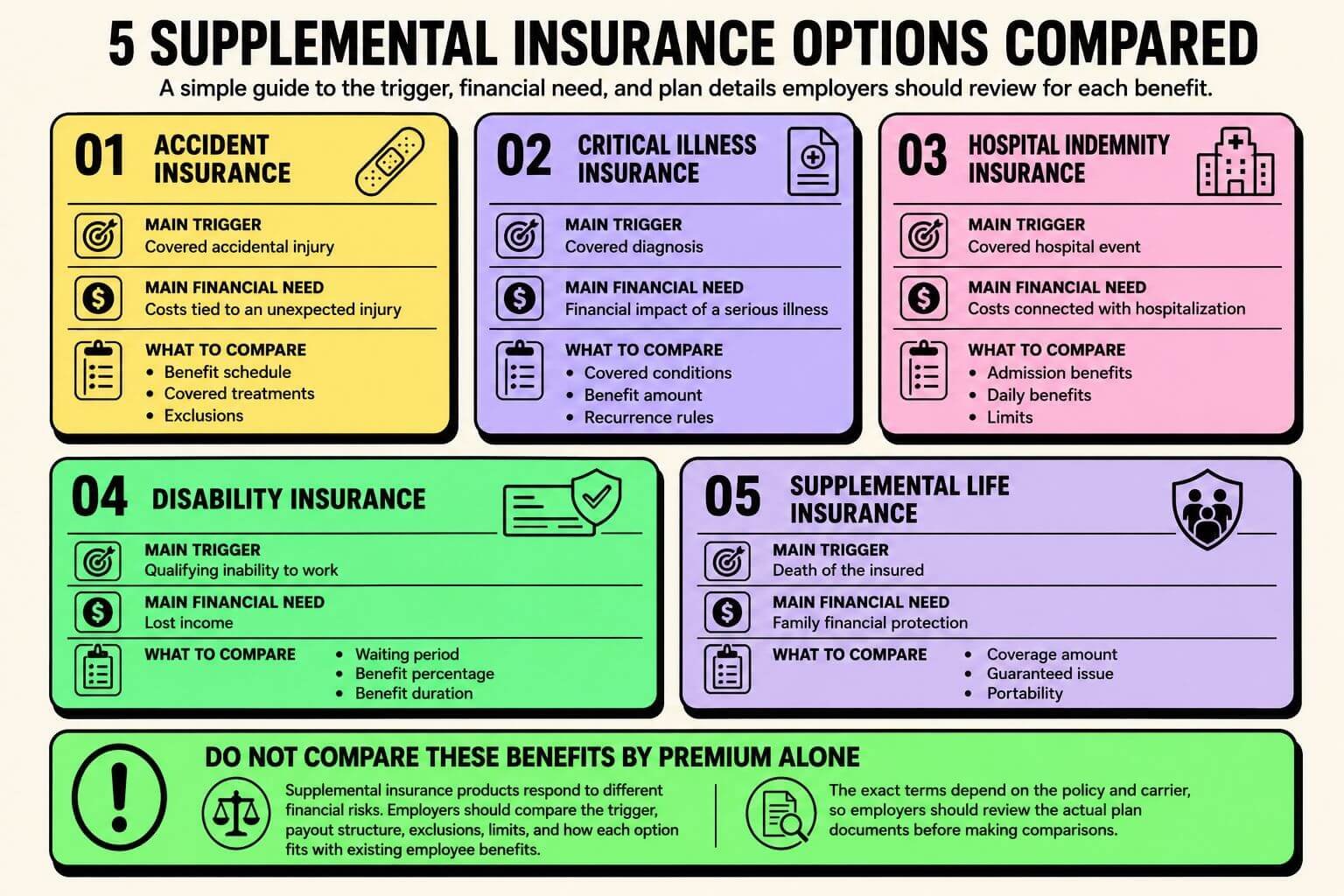
The exact terms depend on the policy and carrier, so employers should review plan documents before making comparisons.
Accident, Critical Illness, and Hospital Indemnity
These three benefits are often offered together, but they respond to different events.
- Accident insurance generally pays specified benefits after covered accidental injuries.
- Critical illness insurance generally pays when an insured person receives a covered diagnosis.
- Hospital indemnity insurance generally pays fixed benefits tied to covered hospital events.
South Carolina’s Department of Insurance makes a similar distinction. It describes hospital confinement indemnity coverage as paying a fixed amount related to covered hospital confinement, while accident-only insurance covers losses resulting from covered accidents. Employers comparing supplemental health options should look at each benefit alongside the medical plan and ask what financial gap it is meant to address.
Disability and Supplemental Life Insurance
Disability and life insurance address different risks from accident or hospital coverage. For disability insurance, employers should compare waiting periods, benefit percentages, monthly maximums, benefit duration, and the policy’s definition of disability.
When reviewing income protection benefits, those terms matter because they affect when an employee may qualify and how much income the policy may replace. For supplemental life insurance, compare coverage amounts, employee buy-up options, guaranteed issue limits, eligibility rules, and portability or conversion provisions.
How Supplemental Coverage Should Fit Your Existing Benefits
A supplemental policy may look useful on its own but add little if employees already have similar protection elsewhere. Review it against the rest of the benefits package, including:
- Medical deductibles
- Coinsurance
- Out-of-pocket limits
- HSA or FSA availability
- Existing disability benefits
- Existing life insurance
- Employee payroll costs
For example, an employer with a high-deductible medical plan may want to examine whether accident, hospital indemnity, or critical illness coverage could address specific expenses employees worry about. The goal is not to fill the enrollment screen with choices. It is to identify gaps employees may realistically face and decide whether another benefit helps with them.
What Employers Often Get Wrong
One common mistake is choosing supplemental benefits mainly by premium. A low-cost option may still be a poor fit if employees do not understand it, the benefit triggers are too narrow for the intended need, or the plan overlaps with something already offered. Other mistakes include:
- Offering several similar products without explaining the differences
- Ignoring exclusions and coverage limits
- Adding too many choices at once
- Overlooking employee affordability
- Failing to review portability
- Treating enrollment and administration as an afterthought
A smaller benefits menu can sometimes be easier for employees to understand than a long list of products with unclear differences.
Compare the Administrative Side Too
The policy itself is only part of the comparison. HR also has to manage the benefit once employees enroll. Check how each option handles:
- Enrollment
- New-hire eligibility
- Payroll deductions
- Billing
- Eligibility changes
- Employee communication
- Claims support
- Benefits-system connections
The right benefits administration technology can make enrollment, payroll updates, eligibility changes, and employee access easier to manage.
This matters most when several voluntary benefits are offered at once. A good plan can still create frustration if deductions are wrong, employees do not understand how to file a claim, or HR has to fix enrollment problems manually.
A Simple Process for Choosing Supplemental Benefits
You do not need dozens of comparison points to start narrowing the choices. Use a simple process:
- Review your current benefits. Identify what employees already have.
- Find the gaps. Look for expenses or income risks that current coverage leaves behind.
- Listen to employees. Use enrollment questions, surveys, or past benefit discussions to understand what they value.
- Compare plan terms. Review triggers, payouts, exclusions, limits, waiting periods, and portability.
- Check affordability. Look at employee cost as well as employer contribution.
- Review administration. Compare enrollment, payroll, billing, claims support, and communication.
- Keep the final choices clear. Employees should be able to understand why each benefit exists and how it differs from the others.
That process helps keep the decision tied to the workforce rather than the size of a carrier’s product list.
Need Help Comparing the Options?
Comparing supplemental insurance gets easier when you review the whole benefits package instead of looking at each policy on its own. An accident plan may fit one workforce, while another employer may find more value in disability, hospital indemnity, critical illness, or a smaller mix of options. Start with your medical coverage, employee out-of-pocket exposure, existing life and disability benefits, employee costs, and the administrative work involved with each option.
Benni Agency helps employers compare supplemental benefits within that bigger picture, including coverage differences, contribution approaches, enrollment requirements, and administration. The goal is not to add as many benefits as possible. It is to choose options employees can understand, afford, and use when they need them. If you are reviewing supplemental benefits for your team, Benni Agency can help you compare the available choices against your current package and workforce needs.