If your group health renewal keeps getting harder to budget for, ICHRA gives you another way to fund employee health coverage. The employer sets a reimbursement allowance, and eligible employees choose qualifying individual health insurance instead of enrolling in one company-selected medical plan.
For employers in Holly Hill and elsewhere in South Carolina, the details matter because plan availability can change by employee location. This article is for business owners and HR teams who want to understand how ICHRA works, what the employer controls, and what to check before considering a change.
Key Takeaways
- The employer sets the ICHRA allowance, while eligible employees choose qualifying individual health coverage.
- Employees submit eligible premiums or medical expenses for reimbursement under the employer’s plan rules.
- There is generally no federal maximum employer contribution, but ACA affordability rules may still apply.
- Employee classes matter when deciding which workers receive ICHRA and how contributions can differ.
- ICHRA works best after comparing budget, employee locations, individual plan choices, administration, and current group coverage.
How Does ICHRA Work for Employers?
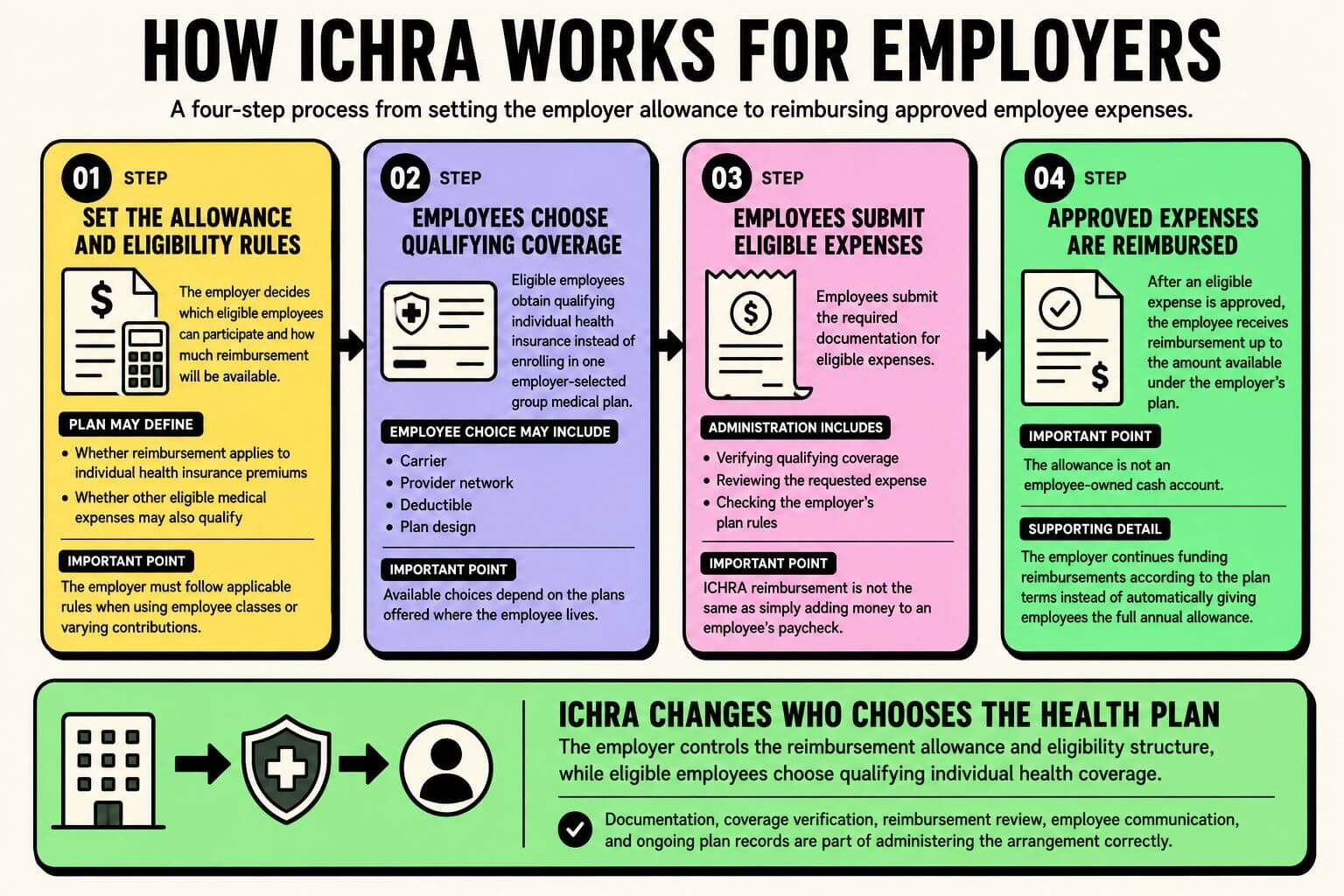
At its core, ICHRA changes who chooses the health insurance policy. With a traditional group plan, the employer selects the plan or plan options. With an Individual Coverage Health Reimbursement Arrangement, the employer decides how much money to make available, while employees obtain their own qualifying coverage. Here is how the process usually works:
1. The Employer Sets the Allowance and Eligibility Rules
The employer first decides which eligible employees can participate and how much reimbursement will be available. The plan may also determine whether reimbursements cover only individual health insurance premiums or other eligible medical expenses.
Employers can use permitted employee classes when designing the benefit. That can be useful for companies with different types of workers, but contributions cannot simply be changed employee by employee without following the applicable rules. Businesses reviewing ICHRA plan options should consider contribution amounts, employee classes, plan administration, and where employees live before setting the benefit.
2. Employees Choose Qualifying Individual Coverage
Eligible employees obtain qualifying individual health insurance rather than joining one employer-selected group medical plan. Certain Medicare coverage can also qualify. That gives employees more control over carrier, network, deductible, and plan design, but their choices depend on what is available where they live.
This matters for a Holly Hill employer with employees spread across South Carolina. According to the South Carolina Department of Insurance, Absolute Total Care and BlueCross BlueShield of South Carolina offer 2026 Marketplace coverage statewide, while other carriers serve selected counties. Plan choice can therefore look different for employees in different parts of the state.
3. Employees Submit Eligible Expenses
Once coverage is in place, employees submit the required documentation for eligible expenses. The employer or plan administrator needs to verify that the employee has qualifying coverage and that the requested reimbursement meets the plan’s rules. The ICHRA reimbursement process is different from simply adding money to an employee’s paycheck. Documentation and proper administration are part of keeping reimbursements within the tax rules.
4. Approved Expenses Are Reimbursed
After an expense is approved, the employee receives reimbursement up to the amount available under the plan. When ICHRA requirements are met, qualifying reimbursements can generally be provided without being treated as taxable wages.
The allowance is also not the same as money placed in an employee-owned account. Employers continue to fund reimbursements according to the plan terms rather than handing over the full annual allowance at once. Reliable benefits administration support can help manage documentation, reimbursement requests, employee communication, and ongoing plan records.
How Is ICHRA Different From Group Health Insurance?
The biggest difference is who selects the insurance plan. Under traditional group health plans, the employer chooses one or more plans, and employees select from those options. Under ICHRA, the employer sets the contribution while eligible employees obtain qualifying individual coverage.
That can give the employer more control over its contribution strategy while giving employees more plan choice. It also shifts some decisions to employees, which means education and enrollment support still matter. Employers comparing ICHRA versus group health should look beyond the monthly premium. Employee locations, provider networks, participation, administration, and workforce preferences can all affect which approach works better.
Who Can Offer an ICHRA?
Employers of different sizes can generally offer ICHRA if the arrangement is structured and administered correctly. It is not limited to very small companies. Small and midsize employers may use it as an alternative to group coverage, while larger employers may use ICHRA within their broader benefits strategy while accounting for ACA employer requirements.
Employee Classes Matter
Federal rules allow employers to organize eligibility around permitted classes, such as:
- Full-time employees
- Part-time employees
- Seasonal employees
- Salaried employees
- Hourly employees
- Employees in different geographic rating areas
- Certain collectively bargained employees
Class rules become especially important when an employer wants to offer ICHRA to one group of employees while maintaining traditional group coverage for another. Before setting up an ICHRA, the employer should confirm that its eligibility and contribution structure follows the applicable class rules.
How Much Can Employers Contribute?
ICHRA generally does not have a federal maximum contribution limit. Employers decide how much reimbursement to make available based on their budget and plan design. That flexibility is one reason employers consider ICHRA. Instead of being tied directly to the full cost of a group premium increase, the company can define its contribution.
But contribution flexibility does not remove ACA affordability considerations. For plan years beginning in 2026, the IRS lists the applicable required contribution percentage at 9.96%. Affordability can affect an employee’s eligibility for Marketplace premium tax credits and can also matter for applicable large employers.
What Employers Need to Know About ICHRA Compliance
ICHRA is flexible, but it still needs a formal structure. Employers should account for:
- Written plan documents
- Employee eligibility and class rules
- Required employee notices
- Proof of qualifying individual coverage
- Expense substantiation
- ACA affordability
- Premium tax credit rules
- Consistent reimbursement administration
The U.S. Department of Labor states that the ICHRA notice generally must be provided at least 90 calendar days before the beginning of each plan year. Different timing can apply when someone becomes eligible later. Premium tax credits also need careful handling. If an ICHRA is considered affordable, an employee generally cannot receive a Marketplace premium tax credit. If it is unaffordable, the employee may be able to qualify for a credit after opting out, assuming the other eligibility rules are met. For employers, this is one area where getting the plan design right before enrollment is much easier than correcting problems later.
When Does ICHRA Make Sense for an Employer?
ICHRA tends to deserve a closer look when a company wants a defined contribution instead of having its budget move directly with a traditional group plan. It can also make sense when:
- Employees live across several rating areas or states
- One group network does not work well for everyone
- Group-plan participation is difficult
- Employees want more control over their coverage
- The employer wants predictable contribution amounts
It is not automatically the better choice. A traditional group plan may still make more sense when employees value a common network, the existing plan is working well, or individual-market options are weak in locations where employees live. The right comparison is based on your actual workforce, not ICHRA in theory.
Is ICHRA a Good Fit for Your Workforce?
Before replacing a group plan, compare ICHRA against what your employees have today. Start with your current contribution, renewal costs, employee locations, participation, individual-market plan choices, and HR workload. Then model a few possible ICHRA allowance amounts and see how those numbers affect employees in different age groups and locations.
Employee experience matters too. A company with people working across several counties may value individual choice. Another employer may find that employees strongly prefer staying on one familiar group network. Benni Agency can help employers compare their current benefits structure with ICHRA without assuming one model is automatically better. A useful next step is simply to put the contribution numbers, available plans, compliance requirements, and employee experience side by side before making a change.
One thought on “How Does ICHRA Work for Employers?”
Comments are closed.