Choosing health insurance for your employees can feel complicated. Employers often compare several plans that look similar but have major differences in cost, coverage, networks, and employee experience. Major medical insurance is the foundation of many employer health plans, but choosing the right option requires more than looking at the monthly premium.
This guide is for business owners, HR teams, and employers who want to understand major medical coverage, compare plans with confidence, and avoid common mistakes when selecting employee health benefits.
Key Takeaways
- Major medical insurance provides broad healthcare coverage for services like doctor visits, hospital care, preventive care, and prescriptions.
- Premium cost is only one part of a plan’s value. Employers should also review networks, deductibles, prescriptions, and employee costs.
- Plan type and funding method are different decisions. PPOs and HMOs describe networks, while fully insured and self-funded options describe how plans are financed.
- Business size affects health insurance responsibilities and options. Employers should understand applicable ACA rules before choosing coverage.
- The best plan balances company costs with employee needs. A lower premium does not always create the best overall benefit.
What Is Major Medical Insurance for Businesses?
Major medical insurance is a type of health coverage designed to help pay for a wide range of healthcare expenses. For employers, it is usually the main health benefit offered through a group health plan. Unlike limited-benefit products that only cover specific situations, major medical plans are designed for everyday healthcare needs and larger medical expenses. Coverage commonly includes:
- Preventive care, such as annual checkups and screenings.
- Doctor visits and specialist care.
- Hospital stays and emergency services.
- Prescription medications.
- Diagnostic services and medical treatments.
For employers, major medical insurance is often the starting point for building a benefits package. The right plan should provide meaningful coverage for employees while staying manageable for the business budget. Employers looking at group health options should also consider how major medical coverage fits into their broader benefits strategy.
Why Major Medical Insurance Decisions Matter for Employers
Offering health insurance is a major decision because it affects both the company and employees. For employees, health coverage can influence whether they can access preferred doctors, afford prescriptions, and manage unexpected medical expenses. For employers, the decision affects:
- Monthly benefit costs.
- Employee satisfaction.
- Recruiting and retention efforts.
- Administrative responsibilities.
- Compliance requirements.
However, choosing a plan based only on price can create problems later. A plan with a lower premium may have higher deductibles, fewer providers, or higher employee costs. The goal is not simply to find the cheapest option. The goal is to choose coverage that works for the business and the people using it.
Understanding Your Major Medical Insurance Options: HMO, PPO, EPO, and POS Plans
Health plans are often categorized by their provider networks and how employees access care.
Health Maintenance Organization (HMO)
HMO plans usually require employees to use a network of approved providers. Employees often choose a primary care physician who coordinates care and provides referrals when needed. These plans can offer lower costs but may provide less flexibility when employees want to see providers outside the network.
Preferred Provider Organization (PPO)
PPO plans typically offer more provider flexibility. Employees can usually visit specialists without referrals and may receive some coverage for out-of-network care.
The tradeoff is that PPO plans often have higher premiums.
Exclusive Provider Organization (EPO)
EPO plans combine some features of HMOs and PPOs. Employees usually need to stay within the plan network but may not need referrals for specialists.
Point of Service (POS)
POS plans combine elements of HMO and PPO designs. Employees may have more flexibility than an HMO but usually follow network and referral requirements. When comparing these options, employers should ask:
- Where do employees receive care?
- Are local hospitals and doctors included?
- How much flexibility do employees need?
- Are the cost differences worth the network differences?
Fully Insured, Level-Funded, and Self-Funded Plans
Plan type and funding method are separate decisions:
- A fully insured plan is the traditional approach where the employer pays premiums to an insurance carrier, and the carrier assumes the claims risk.
- A level-funded plan combines features of both approaches by providing more predictable monthly payments while allowing potential savings if claims are lower than expected.
- A self-funded plan allows an employer to pay employee healthcare claims directly while often using a third-party administrator for plan management.
The right approach depends on factors such as:
- Company size.
- Budget goals.
- Risk tolerance.
- Employee healthcare needs.
Employers comparing these approaches can review the differences between fully insured and self-funded plans before making a decision.
What Businesses Should Compare Before Choosing a Plan
Before choosing a major medical plan, businesses should compare provider networks, prescription coverage, premiums, deductibles, and employee contributions. Looking at these factors together helps employers understand the plan’s true cost and how well it will work for employees.
Provider Networks and Access to Care
A health plan is only valuable if employees can use it. Before choosing coverage, employers should review whether the network includes:
- Local hospitals.
- Primary care providers.
- Specialists.
- Healthcare facilities employees already use.
A plan with a lower premium may not be the best choice if employees lose access to important providers. For companies with employees in different cities or states, network flexibility becomes even more important.
Prescription Coverage and Pharmacy Benefits
Prescription benefits can have a major impact on how employees experience a health plan. Employers should review:
- Which medications are covered.
- How drugs are placed into different cost tiers.
- Specialty medication coverage.
- Pharmacy networks.
- Prior authorization requirements.
Two plans may have similar premiums but create very different prescription costs for employees.
Premiums, Deductibles, and Employee Contributions
Employers should look beyond the monthly premium when comparing plans. Important cost factors include:
- Employer contribution amount.
- Employee payroll deductions.
- Deductibles.
- Copays.
- Coinsurance.
- Out-of-pocket maximums.
For example, a plan with a lower premium may require employees to pay more when they actually need care. According to the 2025 KFF Employer Health Benefits Survey, average employer-sponsored family coverage premiums reached $26,993 annually, showing why employers need to carefully evaluate total healthcare costs rather than focusing on one number alone.
Employee Needs and Plan Usability
The best health plan is one employees can realistically use. Consider different employee situations:
- An employee who mainly uses preventive care.
- An employee covering a spouse and children.
- An employee who regularly uses prescriptions or specialist care.
A plan that works well for one group of employees may not work as well for another. Understanding employee needs can help employers choose benefits that provide better value without creating unnecessary costs.
ACA Requirements Employers Should Understand
Health insurance responsibilities depend partly on employer size and plan structure. Businesses with fewer employees may have different requirements than applicable large employers (ALEs). Under ACA rules, an ALE generally means an employer that averaged at least 50 full-time employees, including full-time equivalents, during the previous calendar year. Applicable large employers may have responsibilities related to offering affordable coverage that provides minimum value.
For 2026 plan years, the ACA affordability percentage is 9.96%. Employers often use IRS affordability safe harbors to determine whether employee coverage meets requirements. South Carolina employers should also understand state-specific insurance considerations. The South Carolina Department of Insurance provides small-business health insurance guidance covering employer market information and coverage considerations. Employers can review official South Carolina small-business insurance guidance before making coverage decisions.
Alternatives and Supporting Strategies Beyond Traditional Group Plans
Traditional group health insurance is not the only approach employers may consider. Some businesses explore options such as:
ICHRA
An Individual Coverage Health Reimbursement Arrangement (ICHRA) allows eligible employers to reimburse employees for qualifying individual health coverage expenses under applicable rules. This approach may provide employers with another way to support healthcare costs while giving employees more coverage choices.
Tax-Advantaged Accounts
Health savings accounts (HSAs), flexible spending accounts (FSAs), and other tax-advantaged accounts can help employees manage healthcare expenses. These options are often considered alongside major medical plans.
Benefits Administration Technology
After selecting coverage, employers still need an effective way to manage enrollment, employee questions, and plan information. Benefits administration technology can help simplify these ongoing tasks.
How Employers Can Make a Better Major Medical Decision
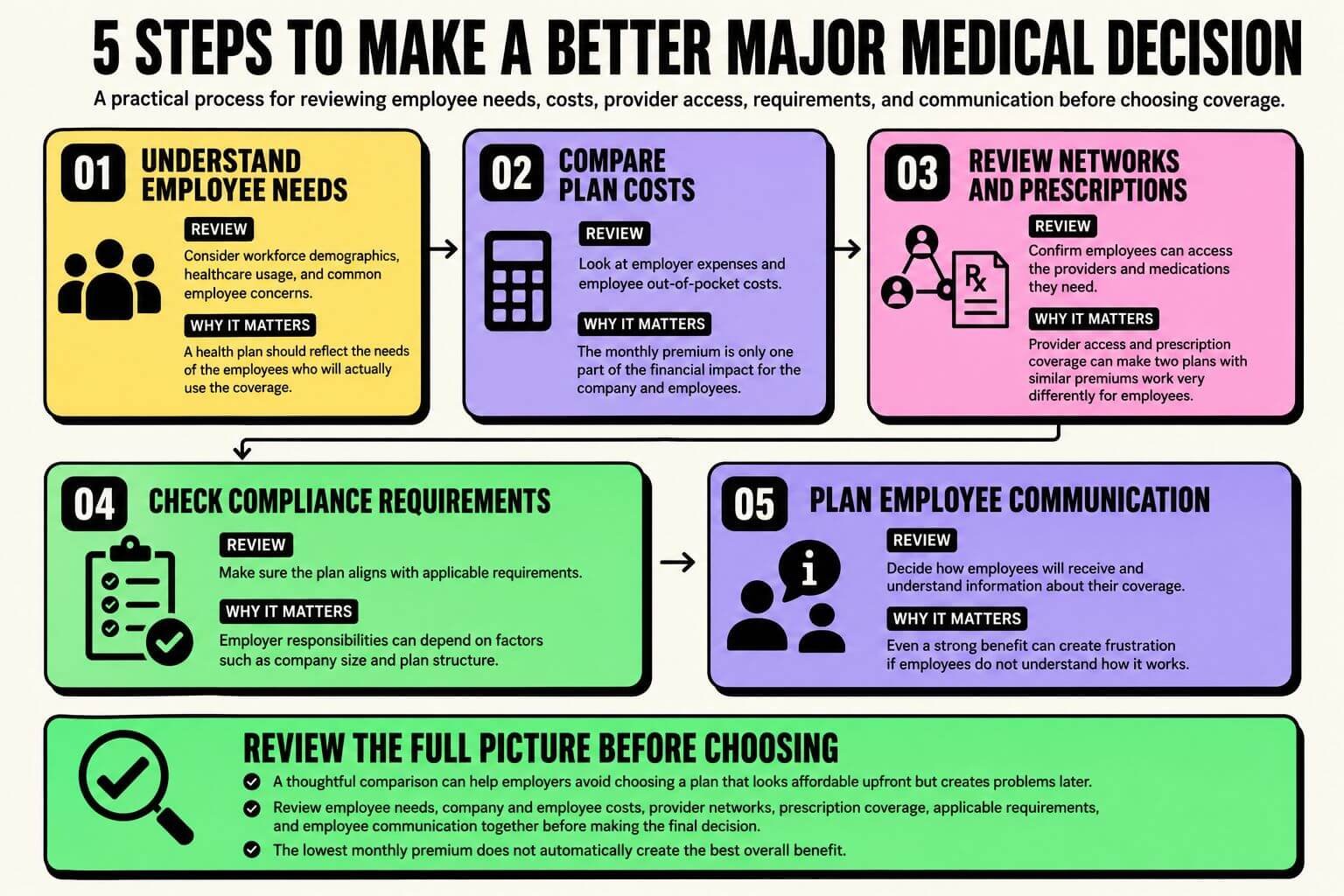
Before choosing or renewing a health plan, employers should review the full picture. A practical review process includes:
- Understand employee needs: Consider workforce demographics, healthcare usage, and common concerns.
- Compare plan costs: Look at employer expenses and employee out-of-pocket costs.
- Review networks and prescriptions: Confirm employees can access the providers and medications they need.
- Check compliance requirements: Make sure the plan aligns with applicable rules.
- Plan employee communication: Even a strong benefit can create frustration if employees do not understand how it works.
A thoughtful comparison can help employers avoid choosing a plan that looks affordable upfront but creates problems later.
Reviewing Your Major Medical Strategy Before Renewal
Choosing a major medical plan is not only about finding the lowest monthly cost. Employers should regularly review whether their current coverage still matches employee needs, business goals, and budget expectations. Before renewal, it helps to compare changes in premiums, provider networks, prescription coverage, employee contributions, and available options.
Benni Agency helps employers review benefit decisions with a focus on understanding plan choices, costs, and long-term strategy. A careful review can help business owners identify what is changing and what options may be worth considering before making a decision. Employers who want a clearer view of their benefits options can start by reviewing their current plan and comparing available approaches.