Renewal season can make a benefits plan feel expensive, confusing, and harder to manage than it should. Rates change, employees have questions, and HR may be stuck fixing enrollment or payroll issues. That is where a broker should prove real value. For Summerville employers, the right broker helps connect cost, coverage, employee needs, and administration before decisions become rushed.
This article is for business owners and HR teams who want to understand what broker value should look like before the next renewal.
Key Takeaways
- A Summerville insurance broker adds value by helping employers make better benefits decisions, not just by collecting quotes.
- The real value often shows up before renewal, when plan design, contribution strategy, and employee needs can still be adjusted.
- A cheaper plan is not always better if it creates more employee confusion, HR work, or coverage problems.
- Local market knowledge matters because Summerville employers compete for talent across the broader Charleston region.
- The right broker should make benefits easier to understand, easier to manage, and more useful for the business.
What a Summerville Insurance Broker Should Really Do
A strong broker does more than shop carriers. That part matters, but it is only one piece of the job. The bigger role is helping employers balance:
- Plan design
- Budget control
- Employee needs
- Administrative workload
- Renewal timing
- Long-term workforce goals
For Summerville employers, the right broker relationship should make benefits easier to plan, explain, and manage throughout the year. This matters because the lowest quote does not always create the best outcome. A plan can look good on paper but still create problems if employees cannot understand it, HR has to fix errors, or the network does not fit how people actually use care. A good broker should help you ask better questions before choosing a plan, not after problems show up.
Why Quotes Alone Do Not Add Enough Value
There is a big difference between getting quotes and getting guidance. A quoting-first broker usually leads with carrier options and premium numbers. That can help, but it does not answer the deeper questions employers face.
For example:
- Can we keep strong health benefits without taking another large budget hit?
- Should we stay with a traditional group plan or evaluate an ICHRA model?
- Are voluntary benefits being used in the right way?
- Are employees choosing the wrong plans because they do not understand the options?
- Is HR spending too much time cleaning up enrollment issues?
An advisor-led broker works backward from those questions. They look at workforce needs, participation patterns, contribution strategy, employee communication, payroll coordination, and growth plans. Then they help recommend a structure that supports the business, not just the renewal deadline.
How Local Market Knowledge Helps Employers
Local context still matters, especially for benefits decisions that affect hiring and retention. Summerville employers are not only competing with businesses down the street. They are part of the broader Charleston-region labor market. According to the Charleston Regional Development Alliance, the region has more than 460,000 skilled workers and added nearly 100,000 workers from 2015 to 2025. That matters because employees often compare the full job offer, not just the paycheck.
They may look at:
- Health insurance options
- Employer contributions
- Dental and vision coverage
- Disability and life insurance
- Voluntary benefits
- Ease of enrollment
- Whether the company explains benefits clearly
A broker with local and regional experience can help employers think through provider networks, workforce expectations, carrier fit, and benefit options that make sense for the area. Local knowledge does not mean local is always better. It means your broker should understand the market your company is hiring in and help you avoid decisions that look efficient but frustrate employees later.
Where Broker Value Shows Up During Renewal
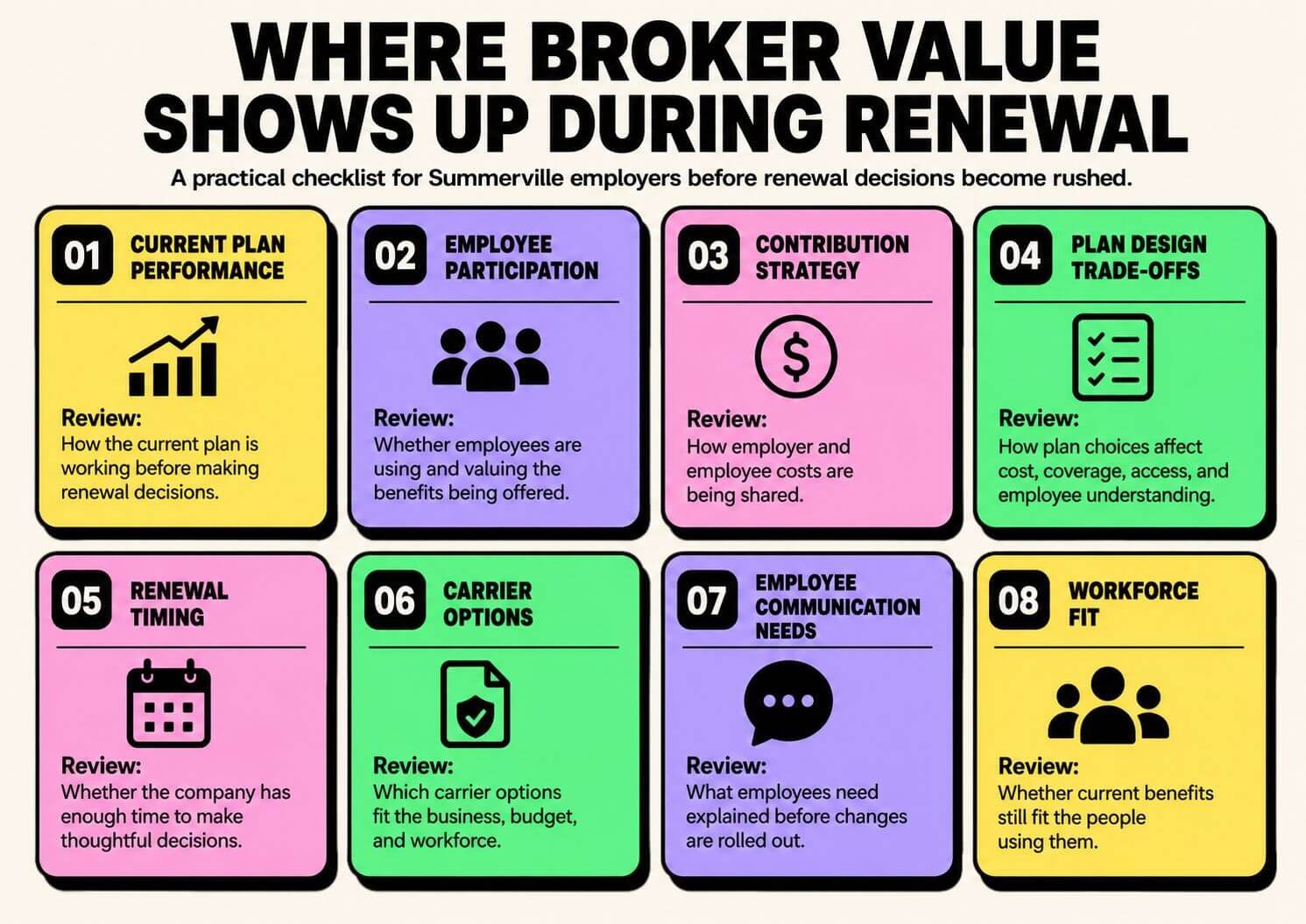
Renewal is often where employers notice whether their broker is proactive or reactive. If the broker only brings a spreadsheet near the deadline, the company may not have enough time to make thoughtful decisions. That can lead to rushed plan changes, unclear employee communication, and budget surprises. A stronger broker helps earlier. They should help review:
- Current plan performance
- Employee participation
- Contribution strategy
- Plan design trade-offs
- Renewal timing
- Carrier options
- Employee communication needs
- Whether current benefits still fit the workforce
For an employer, that is not just an insurance problem. It is a business planning problem. A broker adds value by helping leadership understand the options before renewal pressure takes over. Sometimes the answer is a plan change. Sometimes it is a contribution adjustment. Sometimes it is better education, better technology, or a different structure. The point is to make those decisions with enough time and context.
Technology and Administration Should Reduce HR Friction
A modern broker should not treat administration as the employer’s problem. If benefits are still handled through scattered forms, disconnected systems, and manual updates, the process is costing more than it appears. HR time is still a cost. Employee confusion is still a cost. Payroll errors are still a cost. The strongest broker relationships now pair plan strategy with technology-first administration.
That may include:
- Digital enrollment
- Employee decision support
- Onboarding workflows
- Eligibility tracking
- Payroll coordination
- Reporting
- Life event changes
- Cleaner employee communication
Good technology should reduce missed elections, payroll mismatches, duplicate forms, and back-and-forth questions. But technology is not a fix by itself. A platform only works if it fits the company’s size, process, and support needs. Some employers need automation. Others need more hands-on help because their HR team is lean or their employees need more guidance. A good broker should know the difference.
Benefits Strategy Should Match the Workforce
One of the biggest mistakes employers make is treating benefits like a static package. In reality, benefits should change as the workforce changes. A 25-person company may need simple enrollment, predictable costs, and clear employee education. A 100-person employer may need better reporting, payroll coordination, and a benefits structure that can handle growth. For companies in growth mode, benefits can affect hiring, retention, and employee confidence. A plan that worked last year may not support the same business this year.
Different goals lead to different decisions:
- If retention is the priority, stronger core benefits or better contributions may matter most.
- If affordability is the pressure point, an ICHRA or different plan structure may be worth reviewing.
- If employees want more choice, voluntary benefits may help fill gaps.
- If HR is overloaded, administration and communication may be the biggest issue.
There is no one-size answer. A broker worth keeping should be comfortable saying, “It depends,” and then explaining the trade-offs in plain language. The goal is not to build the biggest benefits package. The goal is to build the right one for the business and the people using it.
Questions to Ask Before Choosing a Broker
A broker relationship should be measured by outcomes, not by how many carrier logos appear in a presentation.
Before choosing or keeping a broker, employers should ask practical questions:
- How early do you start renewal planning?
- How do you help us control costs without weakening the plan?
- How do you explain options to employees?
- What happens after open enrollment ends?
- Who helps with onboarding and life event changes?
- What technology is available for enrollment and administration?
- How do you support payroll coordination?
- How do you help us compare group health, ICHRA, and voluntary benefits?
- How do you help if our company grows?
- What will you do during the year, not just at renewal?
These questions help separate a transactional broker from a real benefits advisor. A good broker should be able to explain their process clearly. They should also be able to show how their support makes benefits easier for leadership, HR, and employees.
Not Sure Your Current Broker Is Adding Enough Value?
A broker relationship should make benefits easier to manage, not harder to explain. If your team only hears from your broker at renewal, or if every plan change creates more confusion for HR and employees, it may be time to look closer at the support behind the quotes.
Start with a simple review.
- Are employees using the benefits you offer?
- Are renewal options explained early enough?
- Is your broker helping with contribution strategy, enrollment, payroll coordination, and year-round questions?
- Are they bringing ideas that fit your workforce, or just another spreadsheet?
You do not need to rebuild everything at once. The first step is understanding where the current setup is working and where it is creating friction. From there, a benefits partner like Benni can help employers think through practical next steps without making the process feel overwhelming. If the current setup feels more reactive than strategic, a benefits review can help you see what should change before the next renewal cycle.