Your company has an insurance agency, but your HR team may still be handling enrollment corrections, employee questions, carrier problems, and rushed renewal decisions. A modern insurance agency should help employers plan, manage, explain, and improve employee benefits throughout the year, not simply deliver plan quotes before renewal.
This article is for business owners, employers, and HR leaders who want to know what their agency should provide, where service may be falling short, and what stronger benefits support looks like.
Key Takeaways
- A modern insurance agency should support employers throughout the year, not only during renewal.
- Plan recommendations should reflect the workforce, budget, provider access, and employee costs.
- The agency should help with technology, eligibility changes, carrier issues, and employee communication.
- Employers deserve clear explanations of plan trade-offs, agency compensation, and included services.
- A strong agency relationship should reduce avoidable work for HR and support better benefits decisions.
What Should a Modern Insurance Agency Actually Do?
A modern insurance agency should act as both a benefits adviser and a practical support resource. It should help leadership make plan decisions while giving HR reliable help with the daily work that follows. That support usually includes:
- Reviewing the employer’s current benefits
- Comparing plan and funding options
- Preparing for renewal early
- Modeling employer and employee contributions
- Supporting enrollment technology
- Explaining benefits to employees
- Helping resolve carrier and eligibility issues
- Coordinating compliance reminders
- Reviewing what worked after enrollment
The agency does not replace the employer’s HR team, attorney, accountant, or benefits administrator. It should know how to work with each of them and make responsibilities clear. Employers should know who handles each issue, when the agency should become involved, and what response they can expect.
Build a Benefits Strategy Around the Workforce
Benefits planning should begin with the people who will use the plans. An agency needs to understand the employer’s workforce before recommending coverage. That includes looking at:
- Workforce size and location
- Employee ages and family needs
- Hiring and retention concerns
- Employer contribution limits
- Employee affordability
- Provider and hospital access
- Administrative capacity
- Expected business growth
A growing company with employees in several states may need a different approach from a small local employer with one office. A workforce with many families may view plans differently from a younger team focused on lower payroll deductions. The agency should ask questions before presenting options. Otherwise, the employer may receive a familiar renewal proposal rather than a benefits strategy based on its actual needs.
Compare More Than Premiums
The lowest monthly premium is not always the best choice. A plan may cost less upfront while exposing employees to higher deductibles, restricted networks, or greater prescription costs. A useful plan comparison should review:
- Employer contributions
- Employee payroll deductions
- Deductibles
- Copays and coinsurance
- Out-of-pocket limits
- Provider networks
- Prescription coverage
- Referral requirements
- Out-of-area coverage
- Administrative demands
South Carolina data shows why these details matter. According to the Agency for Healthcare Research and Quality, the average individual deductible for privately insured employees with single coverage and a deductible was $2,193 during the pooled 2021–2023 period, compared with $1,960 nationally.
An agency should explain how costs may shift between the employer and employees. Leadership can then compare plans based on overall value rather than premium alone.
Recommend the Right Funding and Coverage Options
Renewing the same arrangement every year may be convenient, but it does not confirm that the arrangement still fits the company. A modern agency should be willing to evaluate appropriate options, which may include:
- Traditional group health insurance
- Different employer contribution models
- Dental, vision, life, or disability coverage
- Voluntary supplemental benefits
- Health reimbursement arrangements
- Individual Coverage HRAs
An ICHRA, voluntary plan, or alternative funding structure should not be presented as the right answer for every employer. Each option affects cost, administration, employee choice, and communication differently. The agency’s job is to explain those differences honestly and help the employer decide which structure fits its workforce and goals.
Start Renewal Planning Before It Becomes Urgent
Employers should not receive their first serious renewal discussion a few weeks before a decision is due. Starting early gives the agency and employer time to review:
- Current plan performance
- Expected rate changes
- Workforce changes
- Employee feedback
- Contribution options
- Alternative plans or carriers
- Enrollment technology needs
- Communication deadlines
Early planning also gives leadership time to decide which changes are realistic. A major contribution adjustment, carrier change, or new enrollment system may require input from payroll, finance, HR, and company leadership.
When renewal planning starts late, employers often have fewer choices and less time to explain changes to employees. A modern agency should provide a timeline, identify upcoming decisions, and keep the process moving.
Use Technology to Reduce Work for HR
Benefits technology should solve administrative problems. It should not create another system for HR to manage without support. Depending on the employer’s needs, technology may help with:
- Online enrollment
- New-hire onboarding
- Eligibility tracking
- Life event changes
- Payroll coordination
- Employee document access
- Carrier data transfers
- Benefits reporting
The agency should help the employer choose and set up the right tools. It should also explain who checks data, corrects errors, handles integrations, and supports employees who have trouble using the system. A benefits administration platform can reduce duplicate data entry and manual forms, but only when the setup and service model are clear.
Employers should ask what happens when payroll and enrollment records do not match. The answer should involve a defined process, not HR being sent back and forth between vendors.
Support Employers and Employees Throughout the Year
Benefits work continues after open enrollment. New employees join, others leave, families change, billing questions appear, and carriers sometimes receive incorrect eligibility information. A modern agency should remain available for recurring issues such as:
- New-hire enrollments
- Employee terminations
- Qualifying life events
- Eligibility corrections
- Billing questions
- Carrier escalations
- Plan document requests
- Employee benefit questions
- Renewal preparation
Employers should also know how to request help and who owns each step. A shared inbox, service contact, ticketing process, or defined response schedule can prevent small problems from being overlooked.
Help Employees Understand and Use Their Benefits
Employees cannot make good elections if they do not understand the plans. An agency should help explain:
- The difference between available plans
- Payroll deductions
- Deductibles and copays
- Provider networks
- Prescription coverage
- Enrollment deadlines
- Where to find plan documents
- Who to contact with questions
The goal is not to tell employees which plan to choose. It is to give them enough clear information to make their own decisions. Communication may include enrollment meetings, recorded presentations, benefit guides, comparison sheets, individual support, or online resources. The format should match the workforce. A company with remote employees may need a different approach from a business where most employees work at one location.
Handle Day-to-Day Benefits Issues
HR should not be left alone every time an employee is missing from a carrier system or a dependent is added incorrectly. The agency should help identify the issue, communicate with the right carrier or vendor, and keep the employer informed until the problem is resolved.
Employers should also have access to year-round benefits consulting for employee concerns, carrier questions, compliance reminders, and planning between renewals. This support does not remove every task from HR. It gives the employer a knowledgeable partner who can help find answers and move issues forward.
Help Employers Manage Compliance Responsibilities
Employee benefits involve notices, deadlines, eligibility rules, plan documents, and reporting responsibilities. Missing a step can create confusion for employees and additional work for the employer. An insurance agency may help with:
- Compliance calendars and reminders
- Enrollment and eligibility procedures
- Required notice coordination
- Carrier documentation
- Plan document access
- COBRA or continuation coordination
- Information needed by outside advisers
The exact support depends on the agency’s services and the employer’s plan structure. Employers should ask which tasks the agency handles, which belong to a third-party administrator, and which require legal or tax advice. A benefits agency can help organize the process and identify issues that need attention. It should not claim to replace an attorney, accountant, or other qualified adviser.
Explain Costs, Compensation, and Trade-Offs Clearly
Employers should understand how their insurance agency is paid. Compensation may come from:
- Carrier commissions
- Employer-paid consulting fees
- Technology fees
- Administrative charges
- A combination of these methods
The payment structure does not automatically determine whether the advice is good or bad. The important point is transparency. Employers should ask:
- How is the agency compensated?
- Which services are included?
- Are technology fees separate?
- Do certain projects create extra charges?
- Does compensation vary between carriers or products?
- What support continues after enrollment?
The same honesty should apply to plan recommendations. Every option has trade-offs. Lower employer costs may increase employee expenses. More employee choice may require additional education. A carrier change may improve pricing but disrupt provider access.
Signs Your Current Insurance Agency May Be Falling Short
An agency relationship may need closer review when the same problems appear year after year. Common warning signs include:
- Renewal planning begins too late.
- Recommendations look nearly identical every year.
- Cost comparisons focus only on premiums.
- HR handles most carrier problems alone.
- Employee education is limited or missing.
- Enrollment errors keep returning.
- Service responsibilities are unclear.
- Communication drops after open enrollment.
- Reports or plan reviews are rarely provided.
- The agency cannot explain its compensation clearly.
One missed email does not automatically mean the relationship is failing. Look for patterns. Does the agency prevent problems, or does it mainly respond after something goes wrong? Does it help leadership prepare, or does it wait for the carrier’s renewal? Those answers reveal more than a polished presentation.
What a Strong Employer-Agency Relationship Looks Like
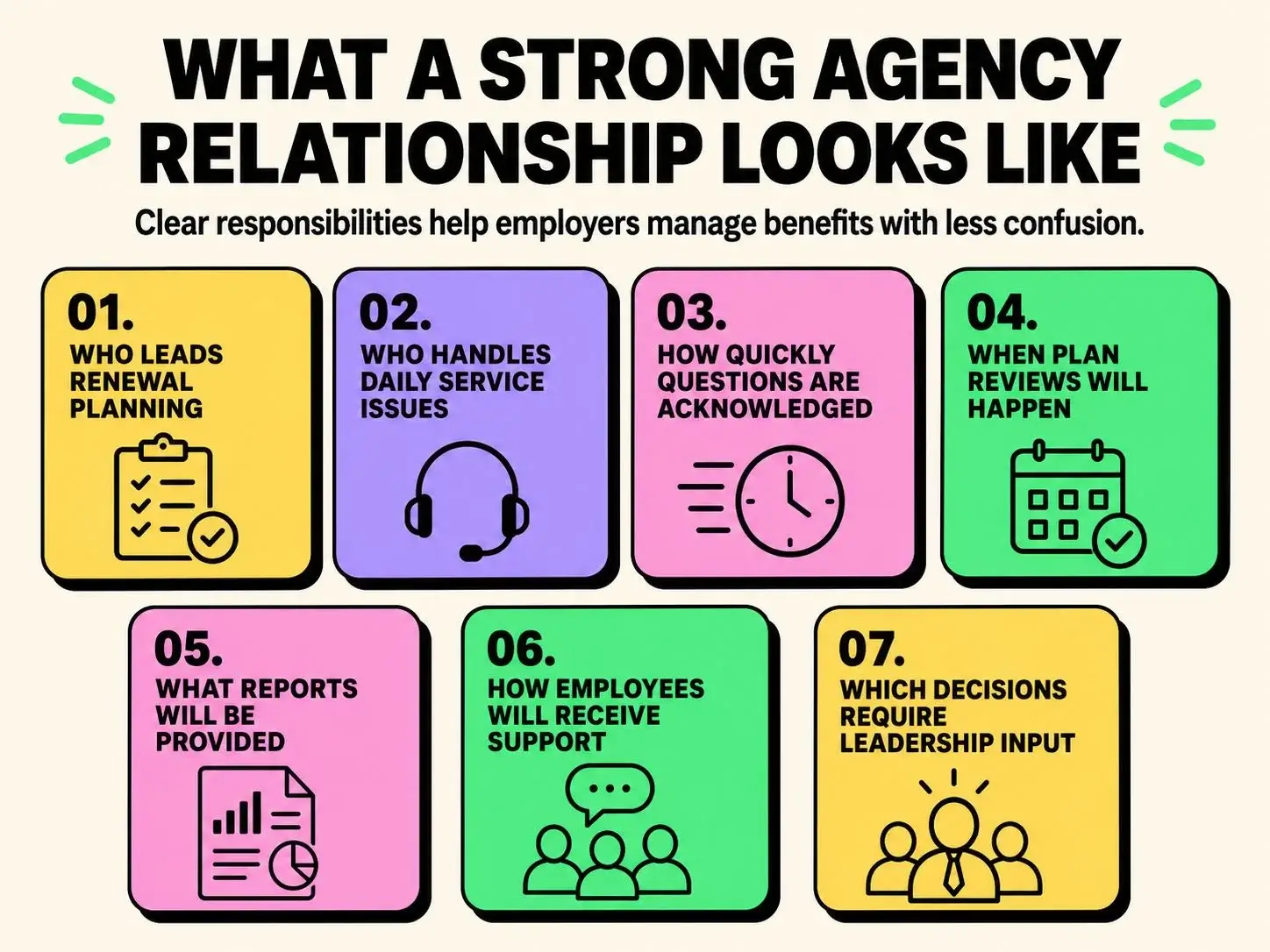
A productive relationship begins with clear responsibilities and honest communication. The employer should know:
- Who leads renewal planning
- Who handles daily service issues
- How quickly questions are acknowledged
- When plan reviews will happen
- What reports will be provided
- How employees will receive support
- Which decisions require leadership input
The agency should also be willing to challenge familiar choices. That may mean recommending a plan change, advising against one, or explaining that the current arrangement still makes sense.
Employers do not need constant change. They need evidence that available options were reviewed and that the recommendation fits the company. The best relationships feel steady rather than reactive. Both sides understand what needs to happen, who owns it, and what comes next.
Is Your Current Insurance Agency Doing Enough?
A good agency relationship should make benefits easier to plan, manage, and explain. Employers should not reach renewal without enough time to compare options, model contributions, prepare employees, and understand the effects of each decision.
Look at the rest of the year too. Does your agency help with eligibility changes, employee questions, carrier problems, reporting, and compliance reminders? Is it clear who takes responsibility when an enrollment or billing issue appears? A gap does not always mean the employer needs to replace its agency. It does mean the service model deserves a closer look.
Benni Agency helps employers review their current benefits process and identify where planning, communication, technology, or ongoing service may need attention. A benefits review can show what is working, what is creating extra work, and what should be addressed before the next renewal.