Renewal season can make benefits problems hard to ignore. Premiums go up, employees ask tougher questions, HR gets pulled into enrollment issues, and leadership starts wondering whether the current plan is still working. A Greenville benefits broker adds value by helping employers make better plan decisions, control costs, reduce admin work, and support employees after enrollment.
This article is for Greenville business owners and HR teams who want a clearer way to judge whether their broker relationship is truly helping the company.
Key Takeaways
- A Greenville benefits broker should do more than collect renewal quotes.
- Good broker value shows up in plan strategy, contribution planning, employee communication, and cleaner administration.
- Renewal support matters because cost increases can affect both the company budget and employee satisfaction.
- Greenville employers need benefits that fit their workforce, hiring pressure, and internal admin capacity.
- If your broker only appears at renewal, the relationship may not be giving your business enough support.
How a Greenville Benefits Broker Helps
A benefits broker should not just gather quotes and hand over a spreadsheet. That may be part of the process, but it is not the full value. A strong broker helps employers look at the full benefits picture, including:
- Plan design
- Employer and employee contribution strategy
- Medical, dental, vision, life, disability, and voluntary benefits
- Employee eligibility rules
- Enrollment process
- Employee communication
- Ongoing service after open enrollment
This matters because the cheapest plan on paper can still create problems. If employees do not understand the coverage, participation drops. If payroll deductions are wrong, HR has to clean up the issue. If employees feel the plan is too hard to use, the company may still struggle with satisfaction and retention. A good broker helps you look beyond premium cost and ask a better question: Will this benefits setup actually work for our people and our business?
How Broker Value Shows Up During Renewal
Renewal is often the moment when employers see whether their broker is adding real value. A weak renewal process usually feels rushed. The employer receives a rate increase, reviews a few options, and has to make a quick decision. That can leave leadership choosing between cost and coverage without fully understanding the trade-offs. A better broker should help you review:
- What changed from the prior year
- Why rates may be moving
- Whether the current plan still fits the workforce
- How contribution changes may affect employees
- Whether alternative plan designs should be considered
- How to explain any changes clearly before enrollment
The goal is not always to find the lowest possible premium. Sometimes a lower-cost plan creates higher out-of-pocket exposure for employees. Sometimes the employer contribution strategy needs to change. Sometimes the plan design is fine, but the communication is weak. The broker’s value is in helping the employer make a clear decision instead of reacting under pressure.
Where Benefits Administration Often Fails
A benefits plan can look strong during a presentation and still create problems after it launches. That usually happens when administration is treated as an afterthought. Enrollment forms, onboarding, qualifying life events, payroll deductions, carrier updates, terminations, ACA-related reporting, and employee questions can create a steady stream of work. For many small and mid-sized employers, those tasks do not sit with a large HR team. They may fall on an office manager, controller, operations leader, or one-person HR department.
That is where broker support becomes practical. A broker who understands administration can help employers use benefits administration tools, digital enrollment, better workflows, payroll coordination, and clearer employee communication. The point is not technology for the sake of technology. The point is fewer errors, fewer repeated questions, and less time spent fixing benefits issues. When administration is cleaner, benefits feel easier for both the company and the employees.
Why Greenville Market Knowledge Still Matters
Local knowledge does not replace good strategy, but it does help. Greenville employers are not making benefits decisions in a vacuum. They are competing for workers across a busy regional market. U.S. Census Bureau QuickFacts shows Greenville County had 15,493 employer establishments and 266,065 total employment in 2023. That gives local employers a real reason to think carefully about how their benefits compare in the market.
That does not mean every company needs the richest benefits package. A 25-person service business, a growing manufacturer, and a professional office may all need different plans. Local market awareness can help a broker understand:
- What types of employers are competing for similar workers
- How benefits affect hiring and retention
- Whether employees need more education around plan choices
- Which benefits are useful versus just nice to list
- How much administration support the employer can realistically handle
The best fit is not just a local broker or a national platform. Employers should want both local understanding and strong execution.
Flexible Benefits Options Can Add Value, But Only When They Fit
Employers have more benefits options than they used to. That can be helpful, but it can also create confusion. Some Greenville businesses may still be best served by a traditional group health plan. Others may need to review options like ICHRA, defined contribution models, voluntary benefits, or different class-based approaches. These options should not be chosen because they sound new. They should be chosen because they fit the company’s size, budget, workforce, compliance needs, and internal admin capacity.
For example, an ICHRA may give an employer more budget control and give employees more plan choice. But it also requires clear communication, proper setup, and support so employees understand how to use it. A strong broker should help pressure-test each option. They should explain what changes for the employer, what changes for employees, and where the risks or trade-offs may be. Flexible benefits can add value, but only when they make the plan easier to manage and easier for employees to understand.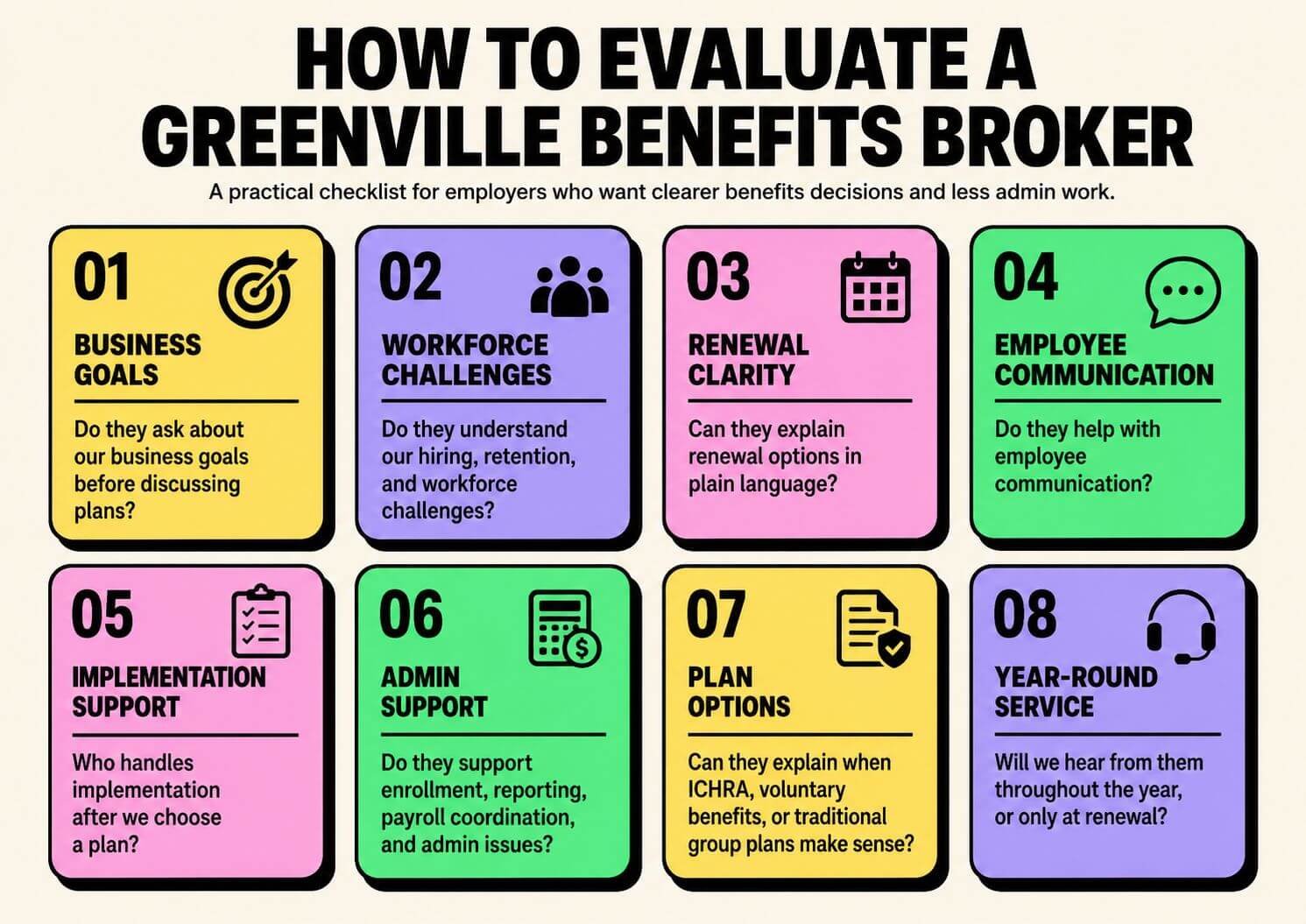
When Your Broker Relationship May Need a Closer Look
A broker relationship is worth reviewing when the same problems keep showing up every year. Maybe renewal feels rushed. Maybe employees do not understand their options. Maybe HR is still managing enrollment through emails, spreadsheets, and repeated follow-ups. Or maybe leadership is unsure whether the current plan is helping with retention, cost control, or employee satisfaction. That does not always mean you need to replace everything. Sometimes the first step is simply looking at what is working, what is creating extra work, and where employees are getting stuck.
Benni helps Greenville employers review their benefits setup, compare practical options, and understand where better plan design or administration support could make the biggest difference. The goal is not to add more complexity. It is to make benefits easier to manage and easier for employees to use. If your current benefits setup feels harder than it should, a local review can help you see what needs to change.