If your company offers an ICHRA, compliance involves more than setting an allowance and letting employees choose coverage. Employers need to manage plan documents, employee eligibility, required notices, coverage verification, reimbursements, affordability, payroll coordination, and reporting.
Missing one of those steps can create extra work for HR and confusion for employees. This article is for business owners and HR teams who want a practical way to review their ICHRA responsibilities, spot gaps, and keep the arrangement organized throughout the year.
Key Takeaways
- Document the plan clearly. Cover eligibility, employee classes, contribution amounts, reimbursement rules, and other plan terms.
- Handle employee notices on time. Confirm who needs the ICHRA notice, when it must be delivered, and keep proof of delivery.
- Verify coverage and reimbursements. Employees need qualifying coverage, and reimbursement requests should be properly substantiated.
- Review affordability when required. Applicable Large Employers should check current affordability rules each plan year.
- Treat compliance as ongoing. Hiring, terminations, eligibility changes, reporting, and plan updates all require attention after launch.
What Should an ICHRA Compliance Checklist Include?
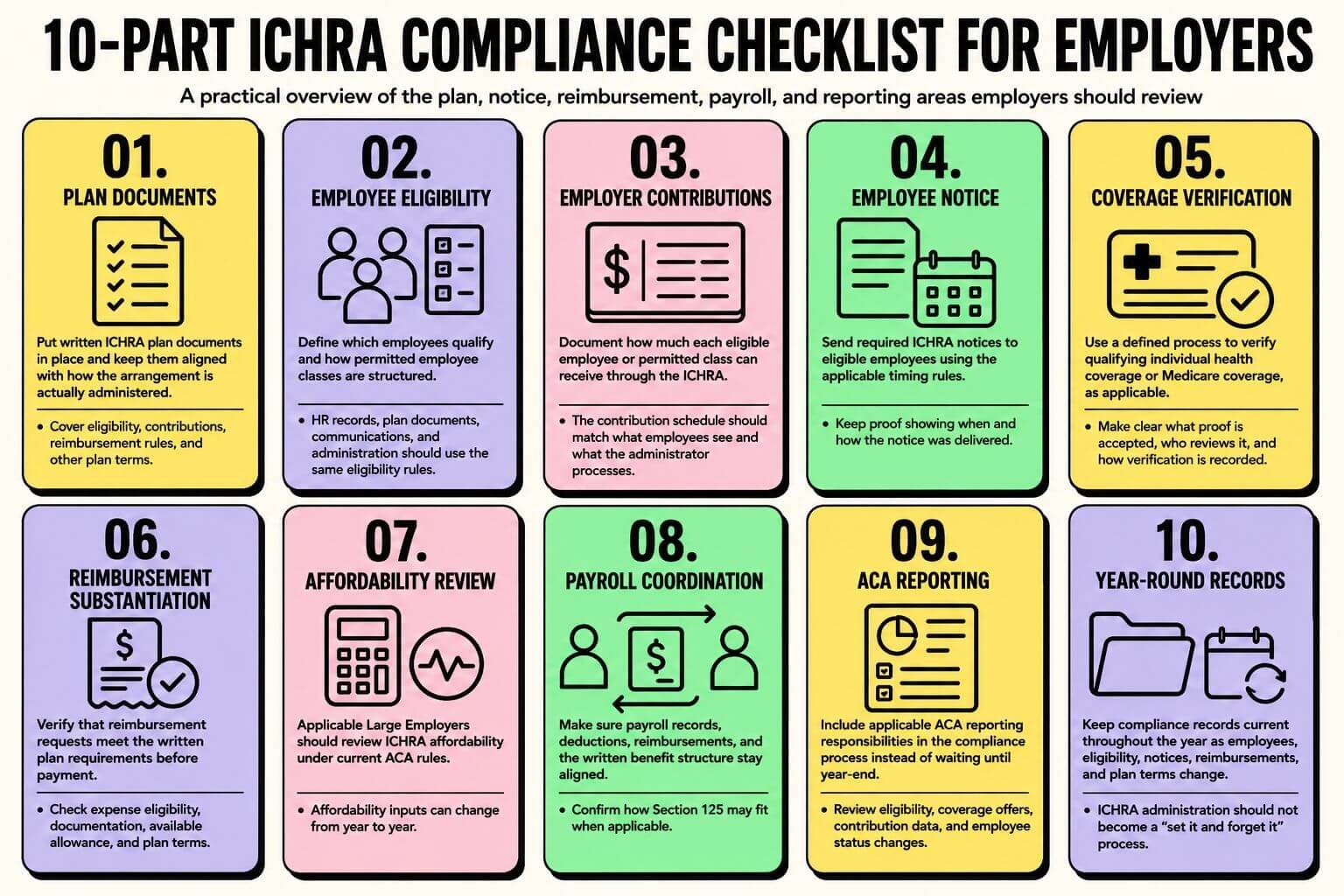
A useful ICHRA compliance checklist should follow the arrangement from initial plan design through year-round administration. Not every employer has identical responsibilities. Employer size, employee classes, plan design, and other factors can change which rules apply. Still, most employers should review the following areas.
1. Put the ICHRA Plan Documents in Place
Start with the written plan. The documents should clearly explain how the ICHRA works, including:
- Who is eligible
- Which employee classes are used
- How much the employer will reimburse
- Which expenses may qualify
- When reimbursements become available
- How employees submit reimbursement requests
- How eligibility changes are handled
- What happens when employment ends
Private-sector employers subject to ERISA should also review applicable plan-document and summary plan description requirements. If the arrangement changes, keep the written documents current. HR should not be relying on an old plan document while payroll or the administrator follows different rules.
2. Define Eligible Employees and Classes
ICHRA rules allow employers to offer different arrangements to certain permitted employee classes. Those classes can include categories such as full-time employees, part-time employees, salaried workers, hourly workers, seasonal employees, and employees working in different geographic rating areas, when the applicable rules are met. Employers should document:
- Which employees qualify
- How each class is defined
- Whether a traditional group health plan is offered to another class
- Whether minimum class-size rules apply
The key is consistency. HR records, plan documents, employee communications, and administration should all use the same eligibility rules.
3. Set and Document Employer Contributions
An employer also needs a clear record of how much each eligible employee can receive through the ICHRA. Contribution amounts may differ under permitted rules, but the structure should be documented before the plan year begins. HR should be able to answer basic questions such as:
- How much does each employee class receive?
- Does the amount vary by age or family size under permitted rules?
- When does the allowance become available?
- Can unused amounts carry forward under the plan?
- How are reimbursement limits tracked?
The contribution schedule in the written plan should match what employees see and what the administrator actually processes.
4. Send the Required Employee Notice
Eligible employees generally must receive an ICHRA notice at least 90 calendar days before the beginning of the plan year. For someone who becomes eligible later, the notice timing works differently. The Department of Labor says the notice should generally be provided by the date the participant first becomes eligible. The notice should explain key information about the arrangement, including:
- The availability and basic terms of the ICHRA
- The employee’s right to opt out
- Important Marketplace information
- How the ICHRA can affect eligibility for a premium tax credit
Sending the notice is only part of the job. Keep proof that it was delivered so HR can show when and how employees received the required information.
5. Verify Individual Health Coverage
Employees generally need qualifying individual health insurance or Medicare coverage, as applicable, for the months they receive ICHRA reimbursements. That means employers need a defined process for substantiating coverage. The process should make it clear:
- What proof is accepted
- When employees provide it
- Who reviews it
- How the verification is recorded
- What happens if qualifying coverage ends
Coverage verification should not be treated as a one-time paperwork exercise if the arrangement requires continued substantiation.
6. Substantiate Reimbursements Before Payment
Proof that an employee has health coverage and proof that an expense qualifies for reimbursement are related, but they are not the same administrative task. Before reimbursing an expense, the employer or administrator should follow the plan’s substantiation process. That usually means checking:
- Whether the expense is eligible
- Whether appropriate documentation was submitted
- Whether the amount falls within the employee’s available allowance
- Whether the request follows the written plan terms
Records should also be handled with appropriate privacy controls. A consistent approval process helps keep reimbursements aligned with the plan instead of leaving HR to make case-by-case decisions.
7. Review ICHRA Affordability When Required
Affordability deserves extra attention for Applicable Large Employers, or ALEs, that are subject to the ACA employer shared responsibility rules. ICHRA affordability depends on factors that can include the employer’s contribution and the applicable lowest-cost silver plan premium available in the employee’s area. CMS provides an ICHRA Employer Lowest Cost Silver Plan Premium Look-up Table that employers can use as part of affordability analysis.
For plan years beginning in 2026, the IRS Section 36B required contribution percentage is 9.96%. That percentage can change from year to year, so employers should check the current federal guidance rather than carrying forward the prior year’s figure. This is one area where an annual review matters.
8. Coordinate ICHRA With Payroll and Section 125
ICHRA administration should also match the company’s payroll process. If an employee needs to pay part of an eligible individual insurance premium that is not covered by the ICHRA, the employer should confirm whether and how a Section 125 plan fits the arrangement and applicable rules. Employers should make sure:
- Payroll records match the benefit arrangement
- Employee deductions are handled correctly
- Reimbursements aren’t incorrectly treated as wages
- The written benefit structure matches the payroll setup
More information about related tax-advantaged benefit arrangements is available through Benni Agency’s Section 125 plan resource. Tax-Advantaged Accounts.
9. Complete Required ACA Reporting
Reporting responsibilities should be part of the compliance checklist rather than something HR discovers at year-end. The exact requirements depend on the employer and arrangement. Applicable Large Employers, for example, should make sure their ACA reporting reflects the coverage offered and the information required under the applicable reporting rules. Before filing season, review:
- Employee eligibility records
- Coverage-offer information
- Affordability records where applicable
- Employee status changes
- Contribution information
- Data shared between HR, payroll, and benefit administrators
Cleaning up mismatched records during the year is usually easier than trying to reconstruct them during reporting season.
10. Keep Compliance Records Current During the Year
An ICHRA does not become a “set it and forget it” benefit after enrollment. HR should keep track of changes such as:
- New hires
- Terminations
- Eligibility changes
- Employee-class changes
- Coverage substantiation
- Reimbursement activity
- Employee notices
- Plan amendments
- Affordability calculations where applicable
This is where administration can become difficult if information lives in several spreadsheets or systems. A benefits administration platform can help HR keep eligibility, enrollment, reimbursement records, payroll data, and reporting in a more consistent process. Benefits Administration Technology. Technology does not replace compliance review, but it can make the records behind that review easier to manage.
When Should Employers Review the Checklist Again?
The checklist should not come out only when the ICHRA is first created. There are several useful points for reviewing it.
Before each new plan year: Check plan documents, employee classes, contribution amounts, affordability where applicable, notices, and administrative procedures.
When hiring new employees: Confirm eligibility, notice timing, coverage verification, and reimbursement procedures.
When workforce structure changes: A change in locations, employee categories, or benefit eligibility may affect how employee classes are handled.
When federal rules or annual figures change: Affordability percentages, Marketplace premiums, reporting guidance, and other annual information should be checked using current sources. A short scheduled review can prevent HR from finding out months later that the written plan and actual administration no longer match.
A South Carolina Example: Why Annual Review Matters
South Carolina employers have a practical reason to check current individual-market information each year. For 2026, the South Carolina Department of Insurance reported a 19.51% weighted average rate increase across individual-market issuers offering Qualified Health Plans through the federal Marketplace. Average changes varied by insurer.
That does not mean every employee’s premium increased by the same amount. It does show why employers should avoid relying on last year’s premium assumptions when reviewing contribution strategy or ICHRA affordability. Individual-market premiums are part of the environment in which an ICHRA operates, and that environment can change from one plan year to the next.
When ICHRA Administration Starts Getting Difficult
The warning signs are often operational rather than dramatic. For example:
- HR is manually tracking reimbursements in spreadsheets.
- Different employees receive notices through different processes.
- Payroll and benefit records regularly need correction.
- No one is sure where coverage substantiation is stored.
- Eligibility changes depend on one employee remembering to update several systems.
- Affordability calculations are rebuilt from scratch every year.
If those issues sound familiar, the first step is not necessarily changing the benefit itself. Start by mapping who owns each task, what records are required, where information is stored, and which steps can be standardized. That usually makes it easier to see whether the problem is plan design, administration, technology, or a combination of the three.
A Practical Next Step for Your ICHRA
An ICHRA can look straightforward until several responsibilities have to work together. Your plan documents may be correct, but HR still has to manage eligibility, notices, coverage verification, reimbursements, payroll coordination, affordability where applicable, and annual reporting. If those pieces are handled by different people or systems, a simple review can help identify where the process needs attention before the next plan year.
Benni Agency helps employers look at the practical side of an ICHRA, including plan structure, employee classes, communication, administration, and how the arrangement fits with the rest of the benefits program. The goal is to make responsibilities clear and keep the process manageable for HR. If you’re unsure whether your current setup covers the items in this checklist, an ICHRA plan review is a reasonable place to start. Individual Coverage HRAs & ICHRA.