Choosing a voluntary benefits broker can be difficult when several firms appear to offer the same accident, disability, life, or supplemental health plans. For Columbia employers, the better comparison is often found in the service behind those products. Look at employee education, enrollment help, payroll coordination, technology, costs, and support after enrollment.
This guide is written for business owners and HR teams who want to compare brokers carefully, avoid service gaps, and choose support that fits their workforce.
Key Takeaways
- Choose a broker with experience supporting employers similar to your company.
- Compare education, enrollment, payroll, and ongoing service, not only products.
- Ask which carriers and voluntary benefits the broker can evaluate.
- Review commissions, technology charges, and implementation costs in advance.
- Verify South Carolina licensing and ask who supports employees after enrollment.
Start With Your Workforce and Benefits Goals
Before interviewing brokers, take a close look at what your company already offers and where employees may need more support. Voluntary benefits can include accident insurance, critical illness coverage, hospital indemnity, disability insurance, life insurance, dental, vision, legal services, and other optional plans. That does not mean every company needs every product.
Start with the problems you are trying to solve. Are employees asking for more financial protection? Is your HR team struggling with enrollment? Are current plans seeing low participation? Do employees understand what they have? Clear goals help you judge whether a broker’s recommendations fit your company or simply add more products.
Review Your Current Benefits and Coverage Gaps
List your current core and voluntary plans before requesting new proposals. Look for:
- Coverage employees frequently request
- Plans with low or declining participation
- Benefits that may overlap
- Common employee questions
- Administrative problems
- Payroll deduction errors
- Benefits that no longer fit the workforce
A broker should review how voluntary options work alongside your core medical, dental, vision, life, and disability benefits. Adding another plan without checking for overlap can create confusion and unnecessary deductions.
Consider How Employees Work and Enroll
Your workforce structure should affect how benefits are explained and offered. According to the U.S. Bureau of Labor Statistics, office and administrative support jobs accounted for 14% of employment in the Columbia metropolitan area in May 2025. Transportation and material-moving jobs accounted for 9.2%, while sales roles accounted for 9.1%.
That mix matters. Office employees may be comfortable using an online enrollment portal during the workday. Shift workers, drivers, field employees, and employees without regular computer access may need mobile tools, flexible meeting times, or individual assistance. Ask each broker how they would reach the people who are hardest to engage.
What Should a Voluntary Benefits Broker Actually Do?
A voluntary benefits broker should do more than provide carrier brochures and an enrollment link. The broker’s work may include:
- Reviewing workforce needs and existing plans
- Comparing products and carriers
- Explaining costs and coverage differences
- Planning employee communication
- Supporting enrollment
- Coordinating eligibility and payroll deductions
- Helping resolve billing or administrative problems
- Directing employees to the right claims resources
- Reviewing participation and renewals
- Recommending changes when workforce needs shift
The exact services will vary by broker. Ask for a written explanation of what is included before making a decision. You should also know who handles each part of the relationship. The person who sells the plan may not be the person who manages implementation, employee questions, or ongoing service.
How to Compare Voluntary Benefits Brokers in Columbia
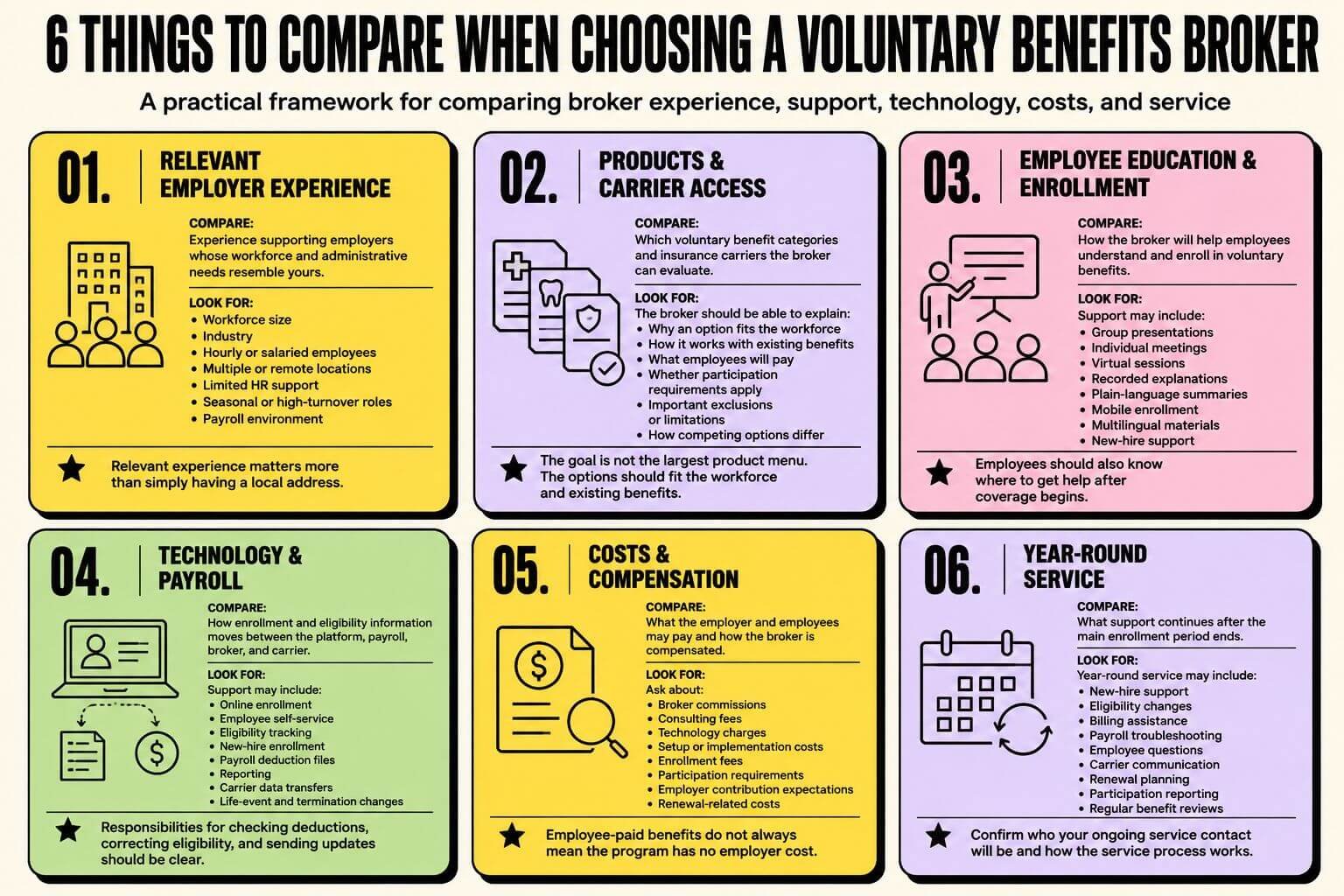
A strong comparison should cover the broker’s experience, available options, technology, costs, and service process. Do not make the decision based only on a product list or polished presentation.
Look for Experience With Employers Like Yours
Ask whether the broker regularly works with companies that resemble yours. Relevant similarities may include:
- Number of employees
- Industry
- Hourly or salaried workforce
- Multiple locations
- Remote employees
- Limited internal HR support
- Seasonal or high-turnover positions
- Current payroll system
A broker offering benefits support in Columbia should be able to explain how its process would work for your workforce, not just describe the plans it can offer. Local experience can be helpful, but a Columbia address alone does not prove that a broker is the right fit. Focus on relevant employer experience and the quality of the service model.
Review the Broker’s Product and Carrier Access
Ask which voluntary benefit categories and insurance carriers the broker regularly works with. Then ask how recommendations are made. A useful broker should be able to explain:
- Why a product fits your workforce
- How it works with existing benefits
- What employees will pay
- Whether participation requirements apply
- What exclusions or limitations employees should understand
- How competing options differ
Be cautious when a broker recommends a specific plan before learning about your employees, current coverage, and administrative needs. The goal is not to offer the largest number of products. It is to offer options employees can understand, afford, and use.
Evaluate Employee Education and Enrollment Support
Voluntary plans depend heavily on employee participation. Participation is difficult to build when employees receive a dense brochure and little explanation. Ask how the broker will educate employees before and during enrollment. Support may include:
- Group presentations
- Individual enrollment meetings
- Virtual sessions
- Recorded explanations
- Plain-language plan summaries
- Mobile enrollment
- Multilingual materials
- Support for new hires
- Help for employees who miss the main enrollment period
The broker should also explain who answers employee questions after coverage begins. Employees may need help understanding deductions, locating policy information, updating beneficiaries, or finding the correct carrier contact. A clear support process reduces the number of questions that fall back on your HR team.
Check Technology and Payroll Coordination
Benefits technology can make enrollment easier, but only when the systems and responsibilities are clearly explained. Ask whether the broker provides or supports:
- Online enrollment
- Employee self-service
- Eligibility tracking
- New-hire enrollment
- Payroll deduction files
- Reporting
- Carrier data transfers
- Life-event changes
- Termination updates
Find out how information moves between the enrollment platform, your payroll system, the broker, and the carrier. Who checks that payroll deductions are correct? Who fixes an eligibility error? How quickly are changes sent to the carrier? These details may seem minor during a sales meeting. They become important when an employee’s deduction or coverage record is wrong.
Understand Fees, Commissions, and Other Costs
Many voluntary benefits are employee-paid, but that does not always mean the program has no cost for the employer. Ask for a clear explanation of:
- Broker commissions
- Consulting fees
- Technology charges
- Setup or implementation costs
- Enrollment fees
- Minimum participation requirements
- Employer contribution expectations
- Renewal-related costs
The broker should be willing to explain how they are paid and whether compensation changes depending on the carrier or product selected. Cost transparency makes proposals easier to compare and helps prevent unexpected expenses later.
Confirm Year-Round Service
Enrollment is only one part of the relationship. Ask what happens during the rest of the year. A strong service model may include:
- Support for new hires
- Eligibility changes
- Billing assistance
- Payroll troubleshooting
- Employee questions
- Carrier communication
- Renewal planning
- Participation reports
- Regular benefits reviews
Find out whether you will have a named service contact and how quickly that person usually responds. A broker who is highly available during the sales process but difficult to reach after enrollment may create more work for your team.
Questions to Ask Before Choosing a Broker
Use the same core questions when interviewing each broker. This makes comparisons more useful and keeps the conversation focused on service. Consider asking:
- How many employers similar to ours do you currently support?
- Which voluntary benefits do you work with most often?
- How do you decide which products to recommend?
- Which carriers can you evaluate?
- How will you educate our employees?
- Who helps employees after enrollment?
- How will enrollment information reach payroll?
- What does implementation involve?
- Which fees or technology costs are not included?
- How are you compensated?
- How often will you review participation and plan performance?
- Who will be our main service contact?
You should also verify that the agency or individual producer is licensed to conduct insurance business in South Carolina. The South Carolina Department of Insurance provides an online database for checking licensed agents and companies. Licensing is a basic requirement. You still need to compare experience, communication, technology, and ongoing support.
Red Flags to Watch For
A broker may not be the right fit when the process feels focused on selling products rather than understanding your workforce. Watch for these warning signs:
- Products are recommended before your current benefits are reviewed.
- Fees, commissions, or technology costs are unclear.
- The broker cannot explain the implementation process.
- No one is assigned to ongoing service.
- Employee education consists only of carrier brochures.
- Payroll and eligibility responsibilities are vague.
- The broker pressures you to add several overlapping products.
- Employees will have no clear place to get help after enrollment.
- There is no plan for reviewing participation or results.
One weak area does not always mean you should reject a broker. It does mean you should ask more questions before signing an agreement or changing your current program.
Compare the Full Service Model, Not Just the Product List
Two brokers may offer similar voluntary plans and still provide very different experiences. One may handle communication, enrollment, payroll coordination, new-hire support, and employee questions. Another may focus mainly on placing the policies and running the initial enrollment.
That difference affects your HR workload and the way employees experience the benefits. The best fit is usually the broker whose service process matches your company’s needs. Products matter, but the support around them often determines whether the program is understood and managed well.
Review Your Voluntary Benefits Strategy
Choosing a broker starts with understanding what your company and employees actually need. Review the plans you already offer, the questions employees commonly ask, how enrollment information reaches payroll, and how much support your HR team receives throughout the year.
You may find that the main problem is not a lack of options. It could be unclear communication, difficult enrollment, overlapping coverage, or limited help after the plans are introduced. Benni Agency helps employers review voluntary benefit options, employee communication, enrollment processes, and administrative needs before recommending changes. The purpose of that review is to identify what fits the workforce without adding unnecessary work or confusion.