Choosing an employee benefits broker in Goose Creek can feel difficult when several proposals offer similar plans and pricing. The right choice depends on more than the initial premium. Look at the broker’s experience, employee support, technology, compensation, renewal planning, and ability to solve problems after enrollment.
This guide is for Goose Creek business owners and HR leaders who want to compare brokers fairly, avoid service gaps, and choose support that fits their workforce.
Key Takeaways
- Compare brokers by experience, service, employee support, technology, compensation, and renewal planning, not premium alone.
- Review your current plans, contribution strategy, employee concerns, payroll process, and renewal date before requesting proposals.
- Ask every broker the same questions so you can compare responsibilities, response times, fees, and included services fairly.
- Confirm who will support employees after enrollment and handle carrier, eligibility, and payroll-related problems.
- Verify the broker or agency through the South Carolina Department of Insurance before making a final decision.
What Should an Employee Benefits Broker Actually Do?
An employee benefits broker should help your company choose, implement, and manage benefits that fit your employees and budget. The broker may review medical, dental, vision, life, disability, and voluntary benefit options. However, presenting insurance quotes is only one part of the job. A dependable broker should also help with:
- Reviewing employee and employer needs
- Comparing carrier and plan options
- Planning employer contributions
- Preparing for annual renewals
- Coordinating enrollment
- Explaining benefits to employees
- Addressing carrier and eligibility issues
- Supporting benefits administration
- Keeping employers informed about relevant compliance concerns
It also helps to understand the difference between each party. The insurance carrier provides the coverage. The broker advises the employer and supports the benefits process. A payroll or benefits administration platform manages data and enrollment tasks, but it does not replace experienced benefits advice. Ask each broker which responsibilities they handle directly and which tasks stay with your HR team, payroll provider, or insurance carrier.
Review Your Benefits Needs Before Comparing Brokers
A broker cannot recommend suitable options without understanding your company. Before requesting proposals, review what is working and where your current benefits process causes problems. This preparation also makes it easier to compare candidates. Each broker will receive the same basic information and respond to the same business needs.
Identify Problems With Your Current Benefits Process
Start by listing the problems your HR team and employees experienced during the past year. Common concerns include:
- Employees do not understand their options
- Questions take too long to resolve
- Enrollment information does not match payroll
- Eligibility changes are missed
- Renewal recommendations arrive too late
- Employees cannot find participating providers
- Prescription costs are difficult to understand
- HR spends too much time contacting carriers
- Fees or broker responsibilities are unclear
Be specific. Instead of saying that communication is poor, note what happened. Perhaps employees did not receive enrollment instructions until the deadline was close, or your team did not know who should correct a payroll deduction. These examples give potential brokers something practical to address.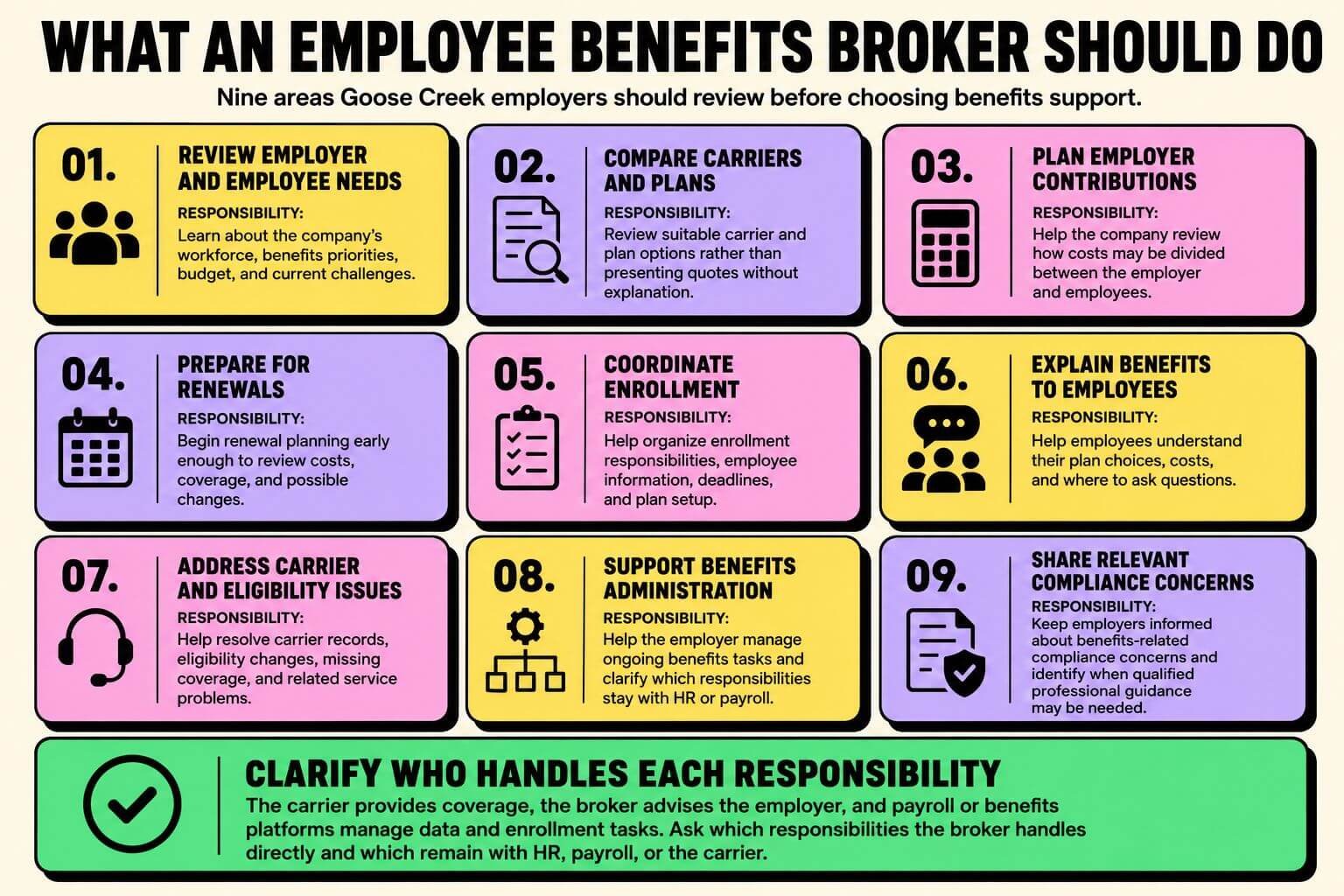
Gather the Information Brokers Will Need
A broker will usually need basic company and employee information before comparing plans. Prepare details such as:
- Employee ages or birth dates
- Employee and dependent ZIP codes
- Eligibility and employment status
- Current plans and carrier information
- Current employer contribution amounts
- Desired coverage or renewal date
- Payroll and enrollment systems
- Provider preferences
- Prescription needs
- Planned hiring or workforce changes
- Employee feedback about current benefits
Ask how the information will be collected, stored, and used. Employee data should be handled carefully, and the broker should explain what is needed before requesting sensitive details.
How to Compare Employee Benefits Brokers
The best broker for one employer may not be the right broker for another. A company with 15 office employees may need different support than a business with hourly workers across several locations. Use the following areas to compare each candidate consistently.
Experience With Similar Employers
Ask whether the broker works with companies that have a similar size, industry, workforce, and HR structure. Relevant experience may include supporting:
- Hourly and salaried employees
- Seasonal workers
- Multiple locations
- Growing businesses
- Employees with different contribution needs
- Employers without a full internal HR department
- Military-connected employees and families
Local context can matter. According to the U.S. Census Bureau, Goose Creek had an estimated population of 52,010 in July 2025, an increase of about 12.9% from the April 2020 estimate base. Census data also reports 4,725 veterans for the 2020 to 2024 period.
A growing and military-connected community can create varied employee needs. A broker should be able to explain how workforce structure, hiring patterns, provider access, and employee communication may affect plan recommendations. The data does not tell employers which plan to choose, but it supports the need for a workforce-specific review. Request references from employers with similar needs. A reference from a much larger company or unrelated industry may not tell you how the broker will support your business.
Carrier Access and Plan Knowledge
Ask which carriers and plan types the broker can review. More carrier relationships can create options, but a long list alone does not prove that the advice will be useful. The broker should be able to explain:
- Why a plan fits your workforce
- Which providers are included in the network
- How employee contributions may affect participation
- How prescription coverage works
- What deductibles and out-of-pocket limits mean for employees
- Whether a fully insured, level-funded, or reimbursement-based approach deserves consideration
- What tradeoffs come with each option
Be cautious when every recommendation leads to the same carrier or funding approach. The broker should explain why the recommendation fits your company rather than presenting one model as the answer for every employer.
Service Before and After Enrollment
A broker’s work should not stop after employees select their benefits. Ask who will help when:
- An employee cannot find an ID card
- A dependent is missing from coverage
- A claim appears to have been processed incorrectly
- A new employee becomes eligible
- An employee loses eligibility
- A payroll deduction does not match enrollment
- A carrier file contains incorrect information
- An employee needs help understanding where to ask a coverage question
You should also know who your main contact will be and how quickly the team normally responds. Ask for the service model in writing. It should explain which tasks the broker handles, how employee questions are managed, how often the plan is reviewed, and when renewal planning begins.
Technology and Administration Support
Benefits technology can reduce manual work, but only when it is set up and maintained correctly. Ask potential brokers:
- Which enrollment platforms they support
- Whether the platform connects with your payroll system
- Who configures eligibility rules
- Who tests payroll deductions
- Who handles employee changes during the year
- Whether your team receives training
- What happens when the platform and carrier records do not match
- Whether there are separate technology or administration fees
Do not judge the system by a demonstration alone. Ask who will perform the actual setup and who will fix problems after launch. A simple system with dependable support may be more useful than a feature-heavy platform that leaves your HR team handling every error.
Compensation and Cost Transparency
Employee benefits brokers may receive carrier commissions, direct consulting fees, technology fees, administration charges, or other compensation. Ask each broker to explain:
- How the agency is paid
- Which compensation comes from carriers
- Whether your company pays direct fees
- Which services are included
- Which services cost extra
- Whether technology fees are separate
- Whether vendor relationships create additional compensation
- How compensation may change if plans or carriers change
Request the explanation in writing. Do not assume every broker service is free because the employer does not receive a separate consulting invoice. Carrier-paid compensation may already be included in the cost of coverage. Transparency does not automatically make one broker less expensive. It helps you understand what your company is paying for and compare proposals more fairly.
Questions to Ask Every Broker
Use the same core questions during every broker interview. Standard questions make it easier to compare answers and notice where responsibilities are unclear. Consider asking:
- What experience do you have with employers of our size and industry?
- Who will be our main contact after enrollment?
- Who answers employee questions?
- Which services are included in your compensation?
- Which services or technology tools cost extra?
- How do you compare carriers and funding options?
- How do you review provider networks and prescription coverage?
- How often will we review plan performance?
- When does renewal planning begin?
- How do you handle eligibility, enrollment, or payroll errors?
- What support do you provide during employee enrollment?
- How do you disclose commissions and other compensation?
- Can you provide references from similar employers?
- How will you document your recommendations?
Pay attention to how clearly the broker answers. A useful response should describe a real process, not rely on broad promises about service or savings.
Warning Signs That a Broker May Not Be the Right Fit
A broker may not be the right match when the service model is difficult to understand or the recommendations do not reflect your workforce.
Watch for warning signs such as:
- The discussion focuses only on premium
- Compensation is not clearly explained
- The broker cannot define response-time expectations
- No one is assigned to employee questions
- The agency does not provide a written service schedule
- Every employer receives the same recommendation
- The broker pushes one carrier without comparing alternatives
- Technology costs appear late in the process
- References are unavailable or unrelated to your business
- Renewal activity begins only a few weeks before the deadline
- Savings or employee outcomes are guaranteed
One concern may have a reasonable explanation. Several unclear answers usually show that you need more information before making a decision.
How to Compare Broker Proposals Fairly
Broker proposals often use different formats. One may focus on rates, while another highlights technology or employee communication. Create a simple scorecard and review every proposal using the same categories:
- Employer premium cost
- Employee contributions
- Deductibles and out-of-pocket costs
- Provider networks
- Prescription coverage
- Plan and funding options
- Broker service responsibilities
- Employee support
- Enrollment process
- Payroll integration
- Technology fees
- Broker compensation
- Implementation responsibilities
- Renewal planning
- References and communication quality
Decide which categories matter most before scoring the proposals. For example, a business with limited HR support may give more weight to employee service and administration. A company struggling with recruitment may focus more closely on employee affordability and provider access. Do not allow one attractive feature to hide weaknesses elsewhere. A low premium may be less helpful if employees cannot use their preferred providers or your HR team inherits more administrative work.
When Should You Start Reviewing Brokers?
Start early enough to gather information, interview candidates, compare proposals, and communicate changes without rushing. The right timeline depends on:
- Your renewal date
- Current broker agreements
- Carrier deadlines
- Company size
- Available employee data
- Technology setup
- The number of plans being reviewed
- Whether you expect to change carriers or funding methods
Begin by checking your current agreements. Confirm whether there are notice requirements, data access rules, or broker-of-record procedures. Next, establish a working calendar for:
- Reviewing current benefits
- Gathering employee data
- Interviewing brokers
- Comparing recommendations
- Selecting plans
- Setting up enrollment
- Testing payroll deductions
- Communicating with employees
- Checking coverage after launch
Switching brokers does not always require changing plans or carriers. Still, beginning early gives everyone more time to confirm responsibilities and fix errors before coverage takes effect.
Measure Whether Your Broker Is Providing Value
A broker relationship should be reviewed throughout the year, not only during renewal. Track practical service indicators such as:
- Response times
- Resolution of employee questions
- Enrollment accuracy
- Payroll deduction accuracy
- Eligibility updates
- Employee participation
- Renewal preparation
- Quality of plan explanations
- Administrative time required from HR
- Whether recommendations reflect company goals
Retention, recruitment, employee satisfaction, and benefit costs may also be useful measures. However, do not assume the broker controls every result. Hiring conditions, wages, management, employee demographics, carrier pricing, and healthcare use can also affect those outcomes. A fair review asks whether the broker completed the agreed work, communicated clearly, helped resolve problems, and gave the company enough time and information to make decisions.
Review Your Current Broker Relationship Before Renewal
A new broker is not always necessary, but it is worth checking whether your current relationship still supports the business. Start by listing the problems your HR team and employees experienced during the past year. These may include slow answers, enrollment confusion, payroll deduction errors, limited plan explanations, or renewal recommendations that arrived too late. Next, review what your broker is responsible for, how compensation is disclosed, and which services cost extra. Compare that information with the support your company will need as its workforce, budget, or hiring plans change.
Benni Agency can help Goose Creek employers review their current benefits process and compare practical options without assuming that every plan needs to be replaced. Employers can learn more about Benni Agency’s Goose Creek benefits support before deciding what should happen next. A short benefits review can help you identify what is working, what needs attention, and which questions to ask before your next renewal.