Renewal quotes can look similar, but the service behind them can be completely different. If you are choosing a Summerville insurance broker for employee benefits, look beyond premiums and compare what the broker will do before renewal, during enrollment, and throughout the year. The assigned team, plan analysis, employee support, technology, and follow-through all matter.
This guide is for Summerville business owners and HR leaders who want to compare a broker’s real service, spot gaps before renewal, and know what support to expect after enrollment.
Key Takeaways
- Compare the broker’s service process and assigned team, not just the quotes they provide.
- Expect a review of your current plans, employee needs, contributions, and administrative problems.
- Ask who handles enrollment questions, eligibility changes, billing issues, and carrier escalations.
- Benefits technology should reduce manual work instead of creating another disconnected system.
- Local knowledge helps, but experience and reliable follow-through still matter.
Start With the Broker’s Service Model, Not the Quote
Several brokers may return similar carrier options. The real difference often appears in who does the work and how that work is handled.
Before choosing a broker, find out:
- Who will manage your account after the sale
- Who answers everyday employer and employee questions
- How renewal planning is scheduled
- What support is provided during enrollment
- How unresolved carrier or billing issues are tracked
- What happens between enrollment periods
A spreadsheet of rates is not a benefits strategy. The broker should be able to explain why an option fits your workforce, budget, contribution approach, and administrative capacity.
Ask for specific answers. If the service description stays vague, it will be difficult to hold the broker accountable later.
Why Local Context Matters in Summerville
A broker serving Summerville should understand how benefit costs, provider access, workforce needs, and hiring conditions affect employers in the area. However, a nearby office does not automatically mean better service.
Cost alone shows why careful planning is needed. The Agency for Healthcare Research and Quality reported that average annual premiums in 2024 for South Carolina private-sector employees enrolled in employer coverage were about $8,181 for single coverage and $24,280 for family coverage.
At those amounts, employers need more than a renewal rate. They need help comparing plan design, employee contributions, networks, and the work required to administer each option.
What Should the Broker Review Before Renewal?
Renewal planning should begin with a review of the company’s current position. A recommendation made without that review may solve the wrong problem.
The broker should look at:
- Current plans and renewal terms
- Employer and employee contributions
- Enrollment patterns
- Employee questions or complaints
- Provider and prescription needs
- Billing or administration problems
- Claims or utilization information when available
- Budget, hiring, and retention priorities
The goal is to understand what is working, what is creating problems, and which changes deserve further review.
Compare Plan and Funding Options
A broker should explain reasonable choices rather than steer every company toward the same model. Depending on the business, the comparison may include fully insured coverage, level-funded plans, or an ICHRA. It may also include voluntary benefits and tax-advantaged accounts.
For each option, ask the broker to explain:
- Expected employer and employee costs
- Budget predictability
- Provider and prescription access
- Administrative requirements
- Risks or disadvantages
- How well the option fits the workforce
ICHRA may suit one employer and create unnecessary difficulty for another. The same is true of level funding and traditional group coverage. A useful recommendation explains the trade-offs instead of presenting one model as the answer for every company.
Balance Employer Costs With Employee Needs
A lower premium does not always produce a more affordable benefit. Employees also feel the effect of:
- Payroll deductions
- Deductibles
- Copays
- Prescription costs
- Out-of-pocket limits
- Provider availability
For example, a plan may lower the employer’s premium but leave employees with deductibles they cannot comfortably manage. Another option may look strong on paper but exclude providers employees regularly use. The broker should help leadership see both sides of the decision before the plan is selected.
Who Handles the Work After Enrollment?
Broker service should not disappear when open enrollment ends. Employers should know who handles:
- New hires and terminations
- Eligibility changes
- Enrollment corrections
- Billing questions
- Carrier escalations
- Employee benefit questions
- Plan documents and notices
- Ongoing employee education
This is especially important for small and midsize businesses where benefits may be managed by an office administrator, controller, or HR team with several other responsibilities.
Employee Questions and Carrier Problems
Employees may need help when coverage is missing, an enrollment record is wrong, or a carrier cannot locate the correct information.
The broker’s team should clarify the problem, direct it to the right carrier or administrator, track the issue, and keep the employer informed. A broker cannot control every claim or carrier decision, but employees should not be left moving between phone numbers without clear direction. Ask who owns these cases and how progress is documented.
Benefits Technology and Administration
Technology is useful when it removes work from the employer’s team. The recommended benefits administration technology should improve tasks such as:
- Enrollment
- Eligibility updates
- Payroll coordination
- Employee access
- Reporting
- Document delivery
The broker should also explain who sets up the platform, checks the data, trains the employer, and handles problems. A new platform is not an improvement if the HR team still enters the same information in several places or spends enrollment fixing avoidable errors.
Compare the Team, Process, and Follow-Through
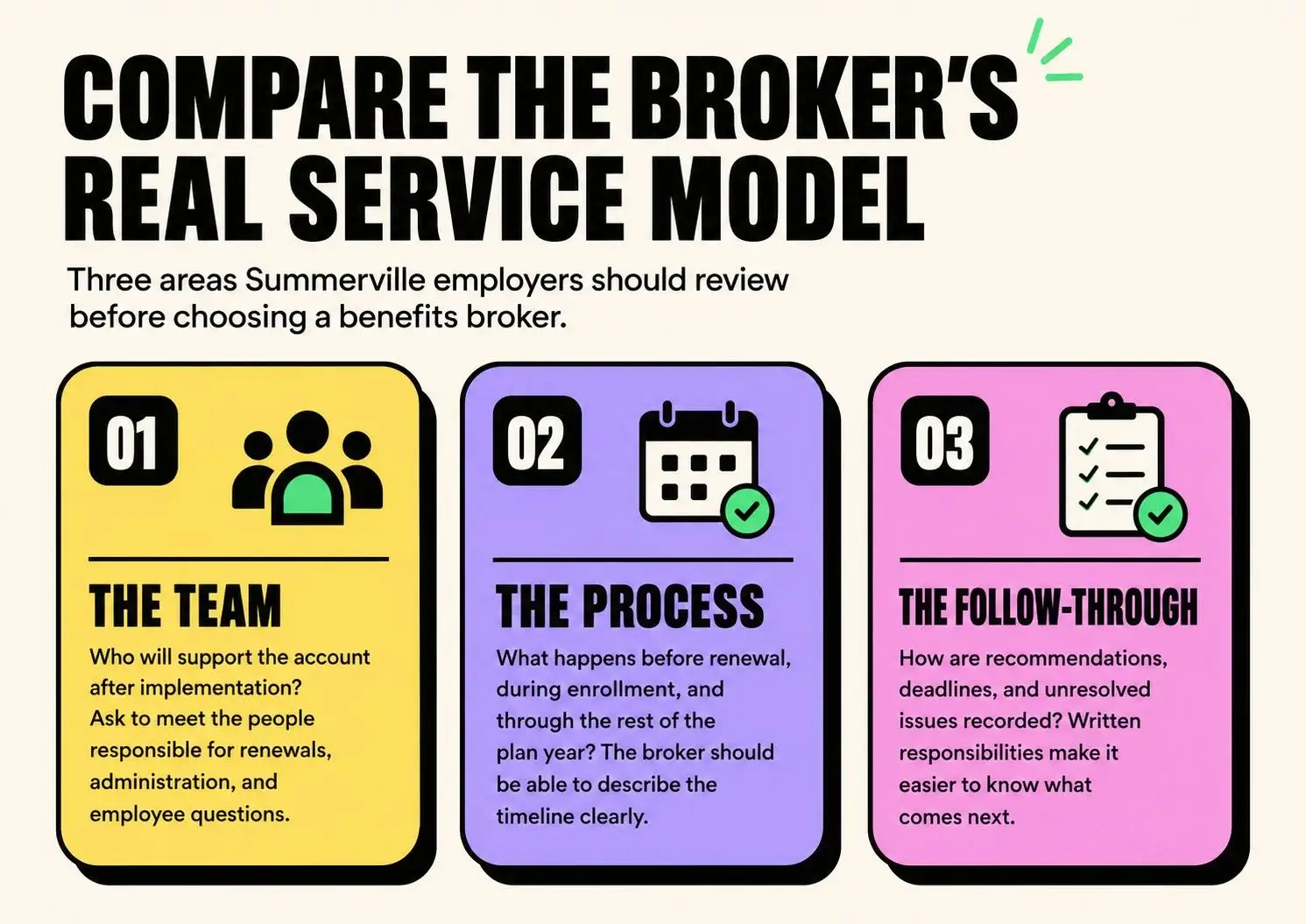
You do not need a complicated scorecard to learn whether a broker’s service model is clear. Focus on three areas.
The team: Who will support the account after implementation? Ask to meet the people responsible for renewals, administration, and employee questions.
The process: What happens before renewal, during enrollment, and through the rest of the plan year? The broker should be able to describe the timeline without relying on broad promises.
The follow-through: How are recommendations, deadlines, and unresolved issues recorded? A verbal commitment is difficult to measure. Written responsibilities make it easier for both sides to know what comes next.
These questions help separate a strong presentation from a service model your company can rely on.
Is Your Current Broker Providing Year-Round Support?
A broker relationship becomes easier to evaluate when you look at the work being done throughout the year. Start with a simple review:
- Did renewal planning begin early enough?
- Do you know who handles employee questions?
- Are billing and eligibility problems followed through to resolution?
- Do recommendations include clear comparisons?
- Does the technology save your team time?
- Does the broker communicate between enrollment periods?
One weak area does not automatically mean you need to change brokers or plans. First, identify the gaps and ask how they will be addressed. A useful response should include responsibilities, timelines, points of contact, and the information used to make recommendations.
Benni helps local employers review these practical service questions. Explore our Summerville benefits support to see what a year-round broker relationship can include.